
Make kefir
Do bigger kefir grains work better?
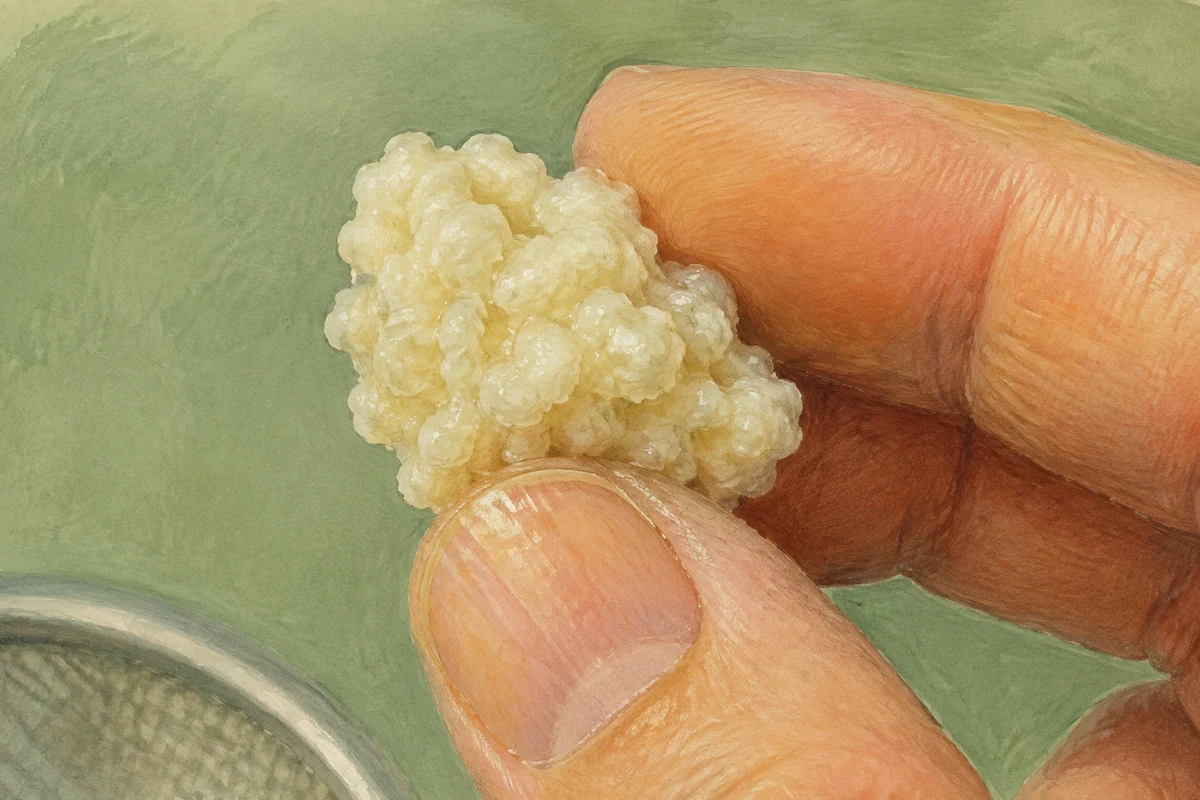
Grain size can change fermentation speed, but bigger grains do not make better kefir. In one controlled milk-kefir experiment, grains divided into pieces around 3 mm changed the study's fermentation signal more than twice as fast as large grains. The experiment did not show better taste, more probiotics, or greater health benefits.
What the experiment actually measured
Researchers placed milk-kefir grains in milk and followed fermentation with magnetic resonance imaging. The changing MR signal closely tracked traditional gas measurements, so they used that signal as a way to compare how quickly the batches were fermenting.
Large grains produced a signal change of about 0.03 arbitrary units per hour. When the grains were divided into pieces around 3 mm, the rate rose to about 0.07 units per hour. The likely reason is surface area: dividing one large cluster exposes more of the grain to the milk.
Those numbers are a laboratory measurement, not a home target. They are not pH points, grams of acid, probiotic counts, or a score out of ten. The useful conclusion is simply that smaller pieces fermented the test milk faster under those conditions.
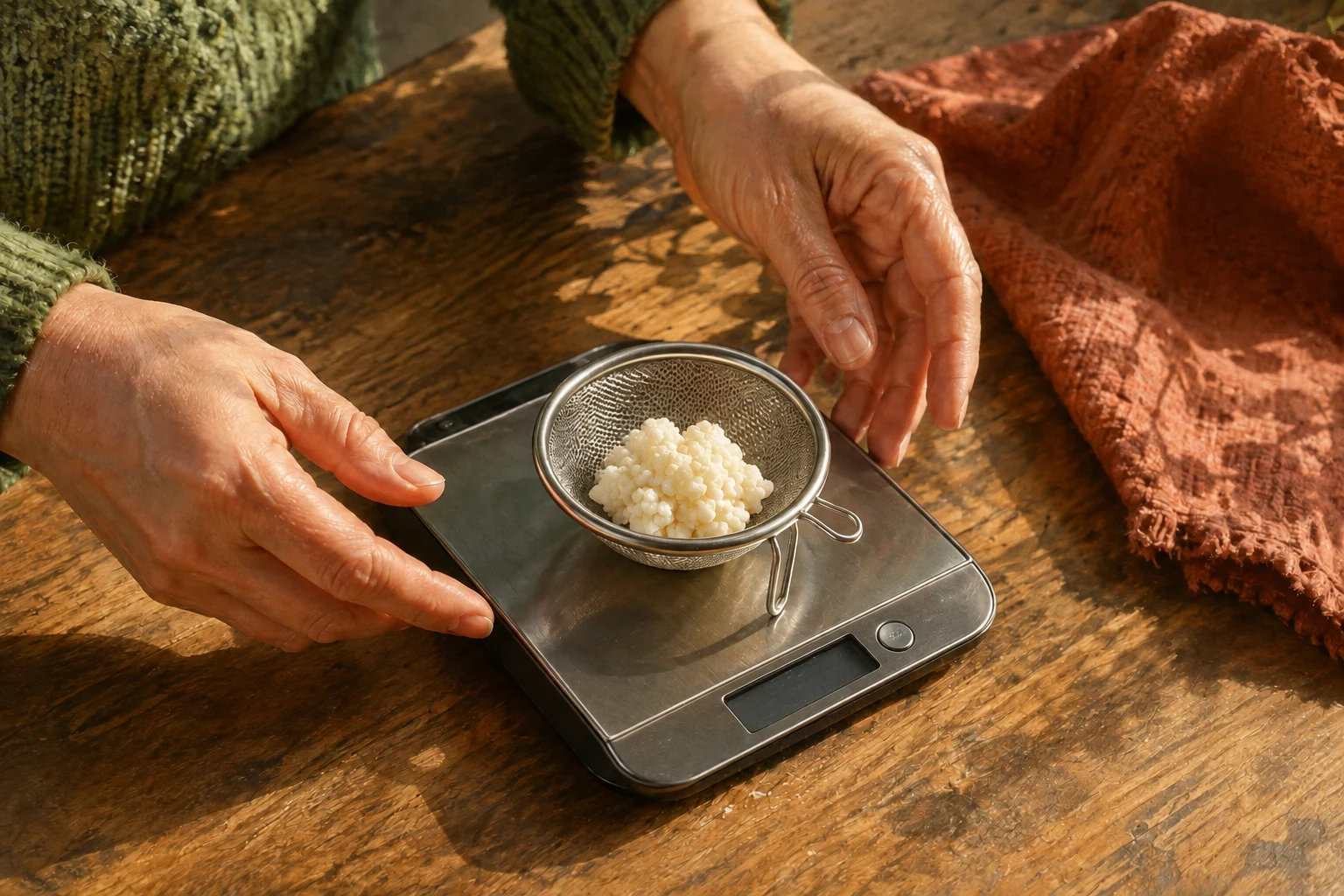
At home, a useful size comparison also holds total grain mass, milk and temperature steady. Changing several of these together cannot isolate the effect of size.
Does more than twice the signal change mean twice the health benefit?
No. The original study used an imaging signal related to fermentation gas. It did not measure a health benefit or probiotic count. If your question is what actually lives in a grain, explore the grain’s microbial community instead.
Faster answers one question, not every question
The experiment measured fermentation rate. It did not compare flavour, creamy texture, lactose digestion, microbial diversity, probiotic count, grain growth, or health outcomes. It did not study water-kefir grains either.
This distinction matters because a faster jar can be less convenient. If small pieces finish at 3 p.m. while you are still at work, their extra speed may make a mild batch harder to catch.
A good culture is one that repeatedly acidifies fresh milk, smells clean, and reaches the finish you enjoy on a schedule that fits your day. A large grain that does this is useful. A small grain that fails to do it needs a culture or process check.
Grain appearance is not a quality grade
Milk-kefir grains can be tiny crumbs, folded ribbons, smooth pieces, lumpy clusters, or cauliflower-like masses. One culture can contain several shapes at once. Grains grow irregularly, join, split during straining, and shed small pieces.
Size alone cannot tell you:
- whether the culture was fed recently;
- whether it survived shipping well;
- how much active grain you received;
- which microorganisms are present;
- how quickly it acidifies your milk; or
- whether the finished kefir suits you.
When buying grains, ask for recent performance and the first-batch ratio. A plain-looking 20 g portion that repeatedly ferments 500 mL tells you more than one large grain with no useful care history.
The variables that usually matter more in a home kitchen
Total active grain amount has a strong effect. More grains working in the same milk generally speed acidification. Temperature changes the pace too. So do milk composition, the condition of the culture after storage or transport, and the point at which you strain.
If an old routine suddenly becomes faster, first weigh the grains and check the room temperature. The culture may have multiplied while Taiwan's weather also warmed the kitchen. Grain size is farther down the list.
If it becomes slower, check that the grains are active, the milk is fresh, and the temperature is within the usual 20 to 25°C process range. A stored or shipped culture may need small repeated feedings. Breaking every grain apart does not repair a culture that is still inactive.
The amount also affects texture. Research on grain-to-milk ratios found that very high inoculation could acidify milk quickly yet produce a less viscous drink, while a low amount acidified slowly. More surface and more speed are not automatic routes to thicker kefir.
Do not blend, mince, or repeatedly cut the culture
The MRI experiment compared defined sizes under controlled conditions. It does not justify putting reusable grains into a blender or finely chopping them. Aggressive damage changes more than surface area, loses tiny pieces through the strainer, and makes a fair comparison impossible.
Healthy grains often separate with gentle handling as they grow. If a cluster divides naturally, keep using both pieces. If you specifically want to test size, separate one spare cluster with clean hands and leave the main culture alone. That gives you a comparison and a way back.
How to run a useful two-jar test
Use this experiment only after the culture is active and producing dependable batches.
- Divide the culture into two portions of equal total weight.
- Leave one portion in larger clusters.
- Gently separate the other into smaller pieces without blending or mincing.
- Put each portion into the same weight and brand of pasteurized milk.
- Keep both jars in the same stable place.
- Record temperature, start time, first thickening, first whey pockets, measured pH, and finish time in the fermentation journal.
- Remove the grains and compare aroma, texture, acidity, and which schedule you prefer.
Repeat the comparison before drawing a conclusion. One jar can be affected by a warmer shelf, a slightly different milk amount, or a grain portion that was less active before the test.
The winner is not automatically the fastest jar. It is the one that makes a clean, enjoyable kefir at a manageable time.
What to change if the small pieces are too fast
Use less total grain, add more milk within the amount you can consume, move the jar to a cooler stable place, or strain earlier. There is no reason to keep dividing a culture that already works too quickly.
If the large grains are too slow, first check total weight and activity. You can gently divide one cluster, but you can also use a little more active grain or less milk. Choose the adjustment that is easiest to measure and reverse.
Whatever the size, a drinking batch should reach pH 4.6 or lower within no more than 36 hours. If an active-looking culture repeatedly fails that acidification check, replace it rather than trying to repair it by cutting the grains.
Milk-kefir results do not transfer to water-kefir grains
The study used milk-kefir grains in milk. Water-kefir grains have a different matrix, community, food, and fermentation pattern. A result for one cannot be pasted onto the other because both happen to be called grains.
Plant-based kefir also adds a different base. Soy, coconut, and oat products set, separate, and acidify differently. If you use a plant base, compare it only with the same base and culture system.
Questions grain owners ask
Should I cut every large grain?
No. Leave a healthy, dependable culture alone. Separate one spare cluster gently only when you have a practical reason to compare speed.
Is there one best grain-to-milk ratio?
No. BCCDC guidance gives a 2% to 10% w/v range for active milk-kefir grains. Choose a measured setup that meets the complete process checks and reaches your preferred texture on a manageable schedule.
Do smaller grains contain more probiotics?
The grain-size study did not count probiotics or measure health effects. Smaller pieces exposed more surface and fermented faster in that setup. Nothing more can be claimed from it.
Are very large grains unhealthy?
Not because they are large. Judge them by repeatable acidification, clean aroma, normal colour, and dependable performance. Unusual colour, fuzzy growth, rotten or chemical smell, or repeated loss of activity is a different issue.
What to change in your next batch
Smaller grain pieces can work faster because more surface touches the milk. Grain health and finished-kefir quality are not measured with a ruler. Keep a culture that performs well, and change size only when a controlled speed adjustment would make your routine easier.
Research behind this answer
- An evaluation of kefir grain size with magnetic resonance imaging, PMID 30801761
- Original grain-size study
- Characteristics of kefir prepared with different grain-to-milk ratios
- BC Centre for Disease Control: Safety of Fermented Foods, section 3.12 Kefir
- A Big World in Small Grain: A Review of Natural Milk Kefir Starters




Comments
No comments yet.
Comments could not be loaded.
Join the discussion