
Making Kefir · Fermentation Physics
Does Kefir Grain Size Change Fermentation? Surface Area, Crumbling Grains, and MRI Data
Fermentation groups love showing off giant, walnut-sized cauliflower kefir grains—as if bigger automatically meant older, wiser, and stronger. Meanwhile, your own jar is full of pale rice-sized crumbs. Run the kitchen physics on both jars, though, and intuition flips right on its head.
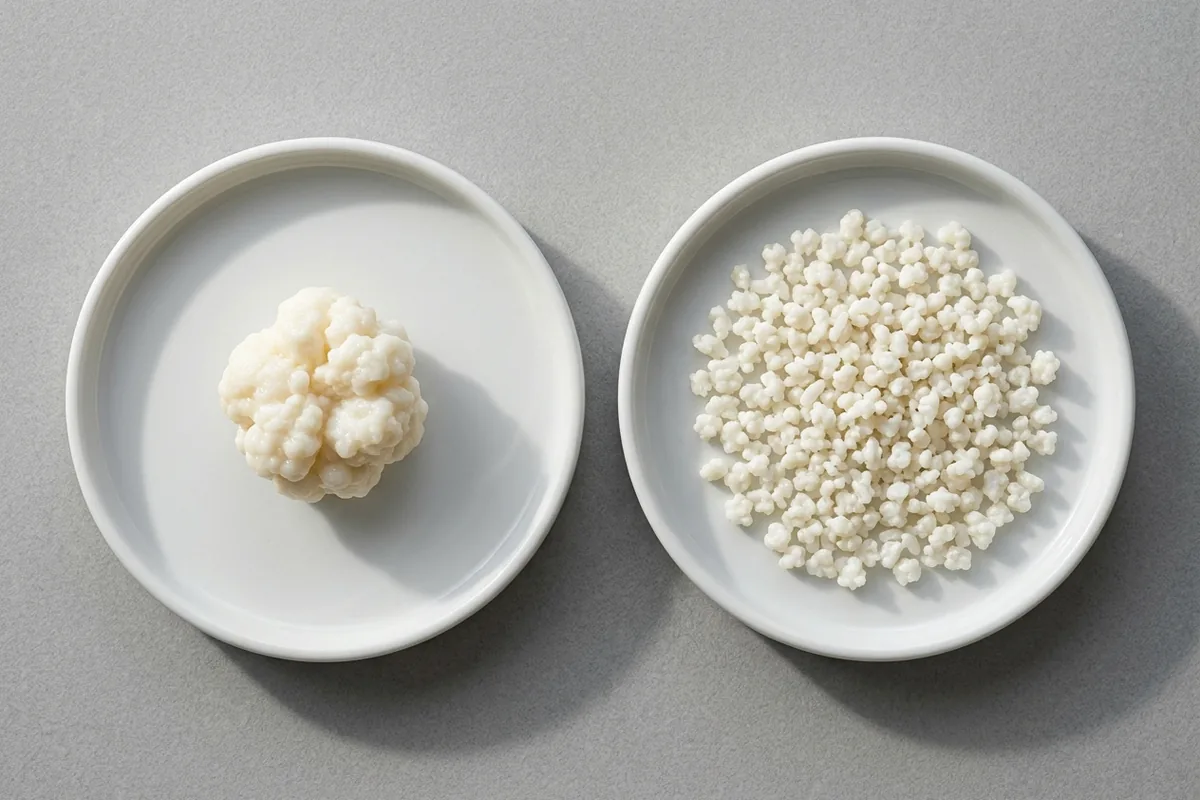
Grain diameter changes how quickly milk contacts the culture—not whether your culture is “premium”:
- Smaller pieces usually run faster: At the exact same weight (say 15 g), many rice-sized grains pack a much higher surface-area-to-volume ratio than one large floret, exchanging lactose and lactic acid faster.
- Crumbling isn’t illness: Healthy grains naturally split as they grow and tumble through strainers. Clean aroma and repeatable acidification beat photogenic cauliflower shapes every time.
- Don’t mince healthy grains: Tiny shreds slip through strainers and overshoot warm afternoons. In real kitchens, total grain weight and room temperature move the clock far more than piece size.
What an MRI study actually measured—and what it didn’t
We don’t have to guess whether grain size shifts fermentation speed. In a controlled study published in Magnetic Resonance in Chemistry (PMID 30801761; DOI: 10.1002/mrc.4853), researchers placed milk kefir grains in milk and tracked fermentation live using magnetic resonance imaging signals closely tied to fermentation gas activity.
Large intact grains changed the MR signal at roughly 0.03 arbitrary units per hour. When grains were divided into roughly 3 mm pieces, that rate jumped to around 0.07 units per hour—more than double the pace. The underlying physics resembles crushed ice versus a single ice cube: same weight, dramatically more outer surface touching the surrounding liquid. Because the outer surface of a kefir grain interfaces directly with fresh milk, smaller pieces put more microbes on the front line at once.
Keep the metaphor strictly in its lane: ice is inert, whereas kefir grains are living biofilms. Just as importantly, that MRI experiment measured rate only. It did not test flavor, silkiness, probiotic counts, microbial diversity, human health outcomes, or water kefir grains. Reading “twice the signal rate” as “twice the health benefit” stretches the data past breaking point.
3-question quiz: test your fermentation physics intuition
Before you start pulling big grains apart—or fretting over tiny rice-like clusters—try three quick myth-busting questions.
Interactive physics quiz · 3 quick myths
Do Bigger Kefir Grains Ferment Better? Test Your Instincts
Q1: Jar A holds one giant 15 g walnut-sized grain. Jar B holds 15 g of tiny rice-sized grains. Same milk, same 24°C counter. Which jar usually finishes first?
Q2: Since ~3 mm grain pieces fermented more than twice as fast in the MRI experiment, does that mean small grains produce higher probiotic counts and thicker kefir?
Q3: Your usual 24-hour kefir suddenly starts over-fermenting and splitting into whey in 12 hours. What should you check first?
Your score:
3/3 — You’ve got grain physics dialed in
You separated surface-area speed from kefir quality and spotted weight and room temperature as the real drivers. Keep whatever grain shape works cleanly with your strainer and daily clock.
Close! Just keep “speed” separate from “quality”
Surface area changes fermentation pace, while weight ratio and room temperature steer everyday texture and flavor. Check the visual breakdown below.
Fermentation physics loves surprising intuition!
Giant cauliflower florets photograph well, yet fermentation responds to surface area, total weight, and temperature—not trophy diameter. The diagram below makes it click in seconds.
Same Weight, Different Geometry: One Cauliflower Floret vs. Many Rice-Sized Grains
Both jars hold 15 g of live milk kefir grains—compare milk-contact area, fermentation pace, and real-world straining ease.
Why grains crumble or stay small—and why shape isn’t a grade
Peek into ten healthy home jars and you’ll see ten different silhouettes: rice-like pearls, folded ribbons, flat wafers, lumpy pebbles, or proud cauliflower heads. As reviewed in PMC7074874 on natural milk kefir grain ecology, grains are living polysaccharide biofilms that expand irregularly, fuse, and naturally bud off smaller fragments during gentle straining. Seeing big and tiny pieces sharing one jar is completely ordinary.
Size tells you remarkably little when shopping for grains, either. A photogenic giant clump can’t tell you when it was last fed, how well it survived shipping, or whether it cleanly acidifies 500 mL of milk in 24 hours. Better questions to ask any seller live in our guide to buying kefir grains.
In day-to-day kitchens, total active grain weight and ambient temperature overshadow grain diameter almost every time. When a steady routine suddenly overshoots and splits, weigh your grains before blaming small pieces—cultures multiply quietly while seasonal heat climbs. And remember Garrote et al.’s grain-to-milk ratio research in the Journal of Dairy Research: very high inoculation ratios acidify rapidly yet can produce lower viscosity (thinner kefir). Staying within practical weight ratios—the BCCDC kefir guidance lists 2%–10% w/v for active milk grains—gives you cleaner control than tinkering with grain size. Fine-tune those levers in our temperature and ratio guide.
Run a fair two-jar test—without grabbing a knife
Curious how much speed difference size makes with your own culture? Test it using surplus active grains while leaving your main colony intact:
- Weigh two identical-mass portions of active grains (for example, 10 g each).
- Keep Jar A in larger chunks; with clean hands, gently pull Jar B apart along natural seams into smaller pieces—never blend or finely chop them.
- Add the exact same weight of fresh pasteurized milk from the same carton, and set both jars side by side at a stable room temperature.
- Log room temperature, start time, first thickening, first whey pockets, and finish time in your fermentation journal across at least two rounds.
The winner isn’t whichever jar finishes fastest—it’s the one that hits your favorite creamy tang right when you’re home to strain it. Regardless of size, every drinkable milk kefir batch must drop below pH 4.6 within 36 hours; tearing weak or stalled grains into smaller pieces won’t rescue an inactive culture.
Watch · Gentle straining for any grain size
Straining Milk Kefir Grains — NW Ferments, Inc.
Pressing grains hard against mesh with a spoon is the fastest way to shred big florets into tiny crumbs. A light shake-and-swirl motion catches small bits while keeping larger grains intact.
One boundary to keep sharp: the MRI study tested milk kefir grains in dairy milk. Water kefir grains run on a different dextran matrix and sugar-mineral chemistry, and plant-milk trials introduce their own base variables—don’t copy-paste milk-grain sizing rules across different systems. Want to zoom inside the biofilm itself? Read What’s Inside Kefir Grains?
Kefir Grain Size FAQ
Should I cut big kefir grains into smaller pieces?
No. If large grains are healthy and fermenting cleanly on a schedule that fits your day, leave them whole—they’re far easier to strain. Only gently divide a spare portion by hand if you specifically want to test a faster pace without adding grain weight.
My kefir grains broke into tiny rice-sized pieces—are they dying?
Usually not. Vigorous spoon-scraping during straining, temperature swings, or the natural habit of a particular lineage often produces smaller pearl-like grains. Judge health by performance: repeatable thickening and clean tangy aroma within 18–24 hours (and below pH 4.6 inside 36 hours), normal ivory/pale-yellow color, and zero foul odors.
Do small kefir grains put more probiotics into my glass?
There’s no evidence for that. The MRI grain-size study tracked fermentation kinetics, not probiotic CFU counts or health outcomes. Smaller pieces contact more milk at once and speed up acidification, which is strictly a timing effect.
How do I stop tiny grains from slipping through my strainer?
Use a fine-mesh nylon or food-grade stainless strainer and strain right as the milk evenly thickens, before heavy curds lock around tiny pieces. If small grains are racing too fast, trim total grain weight by a third rather than chasing finer sieves.
References
- PubMed (PMID 30801761): Magnetic resonance imaging assessment of milk kefir grain size and fermentation kinetics
- Magnetic Resonance in Chemistry: Original kefir grain size study (DOI: 10.1002/mrc.4853)
- Garrote et al. (1998): Characteristics of kefir prepared with different grain:milk ratios (Journal of Dairy Research)
- BC Centre for Disease Control (BCCDC): Fermented Foods Guidance, Section 3.12 Kefir
- PMC7074874: Big world in small grains — review of natural milk kefir starter microbiota