
Make kefir
What to ask before buying kefir grains
Before buying kefir grains, ask for the culture type, recent feeding and a first-batch recipe. Active grains, dried grains and starter powder need different preparation. The seller’s answers should tell you what to have ready and how to recognize normal recovery after delivery.

First, make sure the seller is offering the thing you want
The word "starter" is used for several different products. They do not behave the same way.
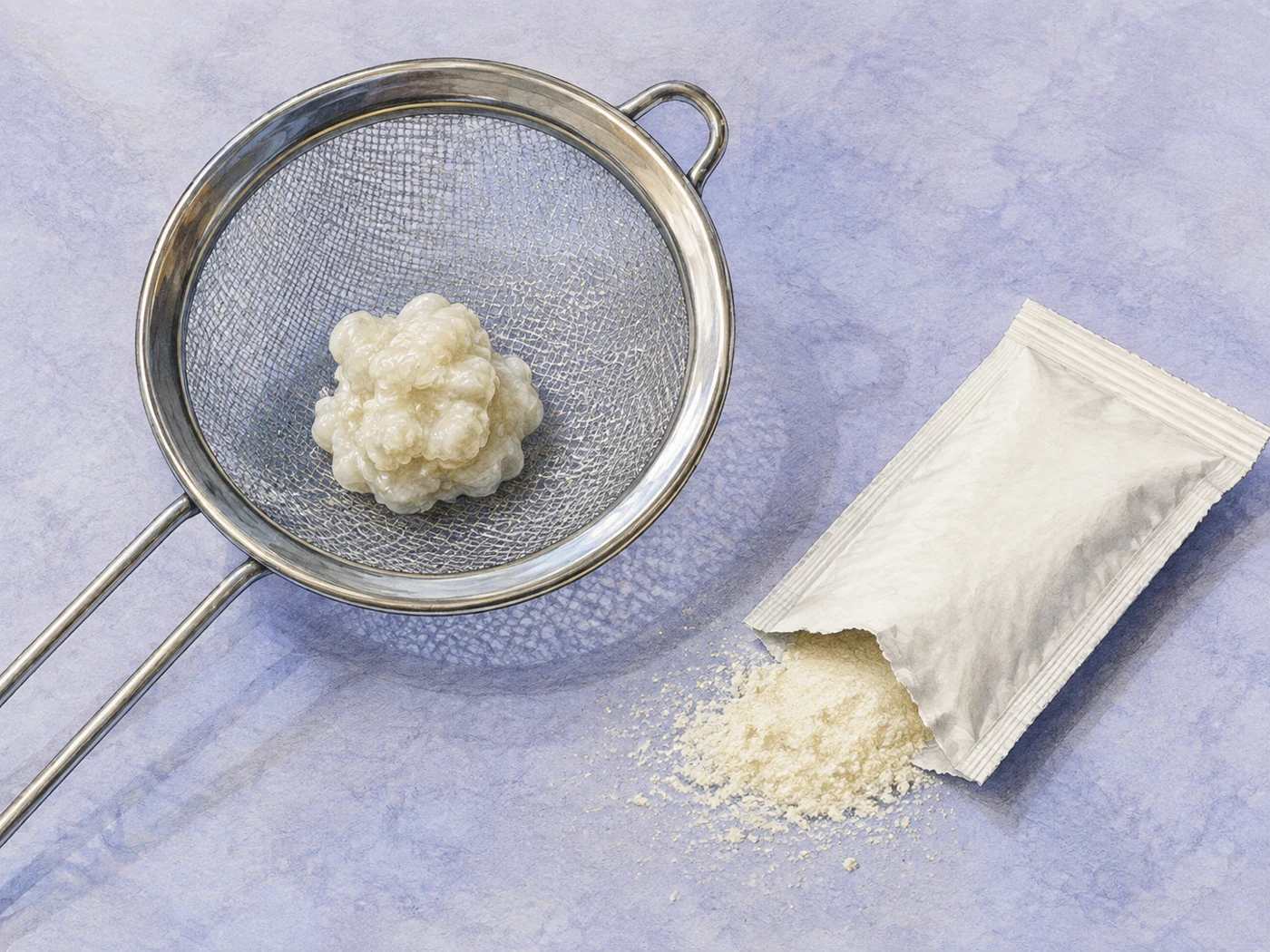
Active wet grains are living, reusable clusters that have recently been fermenting milk or sugar water. They usually need attention soon after delivery. Dehydrated grains are the same kind of reusable culture in a resting state, but they need repeated feedings before they return to normal work. Direct-set starter powder is a measured mixture of selected microorganisms. It can make kefir, but it is not a bag of grains and usually has a limited number of reuses.
Milk-kefir grains and water-kefir grains are also different cultures. White, cauliflower-like milk grains belong in milk. More translucent water-kefir grains belong in sugar water. They require different ingredients and care.
Ask the seller to name the specific product in ordinary language:
- active wet milk-kefir grains;
- dehydrated milk-kefir grains that need revival;
- active or dehydrated water-kefir grains; or
- direct-set starter powder with its intended base and number of batches.
If the answer slides between these categories, stop there. The arrival instructions, first recipe, and expected recovery time all depend on which culture is in the package.
The listing says “starter” but never shows reusable grains. What should I ask?
Ask whether you will strain physical grains for the next batch or use a powder with stated reuse limits. Do not assume a sachet will grow grains. Compare the two culture systems before buying equipment or milk.
Ask how the culture has performed recently
Kefir grains contain a mixed community of bacteria and yeasts, and that community changes with the grain source, food, temperature, ratio, storage, and handling. A laboratory result from one sample cannot promise fixed contents in every future batch.
The seller should still know how the culture has behaved recently. Ask these questions before paying:
- What have the grains been fed?
- How much grain was used with how much milk or sugar water?
- At roughly what temperature were they kept?
- When did they last complete a normal batch, and how long did it take?
- How will they be packed, and how long should delivery take?
- What should I do during the first hour after arrival?
- What changes are normal during recovery, and what means the culture should be replaced?
Ask for concrete details: the milk or sugar-water recipe, grain and liquid amounts, normal room temperature, last successful feeding and delivery instructions. A long species list or an origin story cannot substitute for that current information.
Reddit · r/Kefir · u/dendrtree
Name the culture before arranging a handover
“Milk” or “Water” · “Will meet” and/or “Will mail”
In this public grain-sharing post, r/Kefir moderator dendrtree asks people to name milk or water grains and say whether they can meet or mail them.
The post establishes culture type and handover options. It does not verify each donor’s grains. Ask when they last received fresh milk or sugar water, how they will travel, and what to do on arrival. Keep street addresses out of public comments.
Read the original post on Reddit (new tab)Loading the post connects to Reddit. The explanation above remains available without loading it.
A photograph shows appearance, not performance
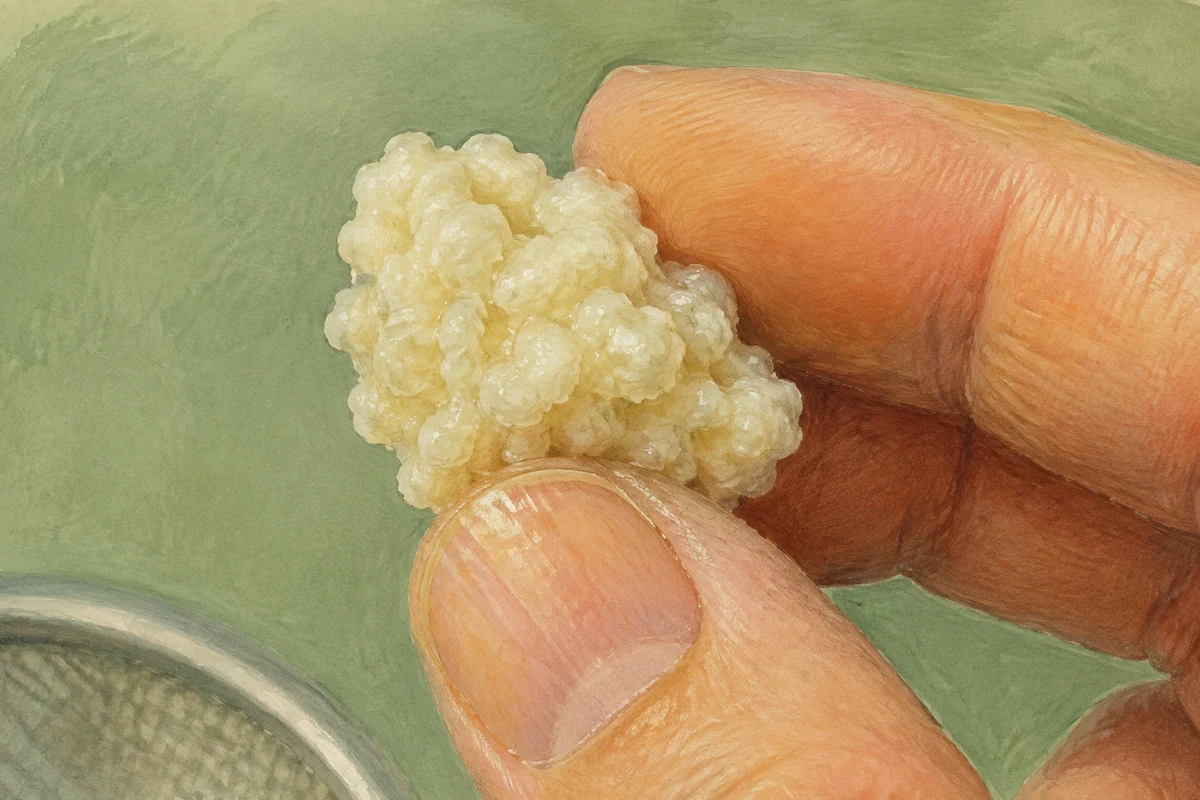
Healthy milk-kefir grains can be large, small, smooth, folded, ribbon-like, or shaped like tiny cauliflower pieces. Water-kefir grains may be clear, cloudy, large, or broken into smaller crystals. Grain size and beauty do not prove that the culture can acidify its food on schedule.
Ask for a recent batch description alongside the listing photograph. A modest-looking portion that repeatedly ferments the stated amount is more useful than a dramatic handful that has been hungry for two weeks.
The amount also needs to match the first recipe. A common milk-kefir starting range is 2% to 10% grain by weight for the milk volume. The current Kefir.tw first-batch method uses 15 to 30 g of active grains with 500 mL of milk. More grain is not an automatic upgrade. It can make the batch acidify too quickly, separate early, and create more culture than you can feed.
Transport becomes part of the culture's history
Active wet grains keep changing during travel. Their packing liquid may become sour, thick, fizzy, or pressurized. Heat, cold, and delay can leave the first batch slower or less balanced than the seller's normal batch. Dehydrated grains tolerate a different journey, but they need a longer revival after arrival.
Before delivery day, prepare the correct food, a clean jar, a clean strainer, and the seller's written instructions. If the package leaks or arrives damaged, photograph it and contact the seller before use. Do not start with a litre of milk simply because the grains looked impressive online. A small first feeding makes recovery easier to see and wastes less if the culture did not travel well.
Recovery is not proved by one bubble or one thicker patch. For milk grains, look for repeated clean acidification, a normal tart aroma, and a more predictable finish across several fresh-milk feedings. Dehydrated or frozen grains can take longer to return to normal activity. Follow the product-specific revival plan instead of treating every quiet first jar as dead.
Ask the allergy question before checkout
Milk-fed kefir grains have a dairy history. Rinsing them does not make them suitable for someone with milk-protein allergy, and shared jars, strainers, or packing liquid create more routes for dairy contact.
If milk allergy matters in the household, do not buy ordinary milk-fed grains and hope to wash the problem away. Choose water-kefir grains maintained without dairy, or a plant-kefir starter that is explicitly dairy-free. Ask about shared equipment and packing ingredients as well as the culture itself.
Lactose intolerance is a different question. Some people digest fermented milk kefir more comfortably than milk, but milk kefir still contains lactose unless the finished product has been tested and labelled otherwise. If you need a fully dairy-free route, choose a culture and equipment with no dairy history.
Decide whether you want a culture or a simpler routine
Buy living grains when you want a reusable culture and are willing to feed it, observe it, and accept some seasonal variation. Buy dehydrated grains when easier transport matters and you are prepared for a revival period. Choose a direct-set starter when defined ingredients and a short, predictable cycle matter more than maintaining grains.
The correct purchase is the one whose identity, instructions, and recent performance match the drink you want to make.
Your arrival kit
Have these ready before the package appears:
- the correct pasteurized milk or tested sugar-water recipe;
- a clean food-grade jar with enough room for the batch;
- a clean non-reactive strainer for reusable grains;
- a label for the culture type and arrival date; and
- the seller's first-feeding and replacement policy.
Keep the first batches small and consistent. Once the culture repeatedly meets the method’s process checks, you can compare another milk or try flavouring the finished drink.
Questions buyers usually ask
Do I need an exact strain list?
No. A current test can describe the tested sample, but it cannot guarantee the same balance in every later batch. For buying grains, recent feeding, transport, and repeatable acidification tell you more.
Are bigger grains better?
No. Size can change fermentation speed, but healthy performance matters more than appearance. Buy the amount needed for a tested first-batch ratio, not the biggest clump in the photograph.
Should I buy a backup portion?
Only if you can keep it separately and feed or preserve it correctly. Two portions in the same jar share the same accident.
Can I buy milk grains and use them for water kefir?
No. Milk- and water-kefir grains are separate cultures with different foods and care routines.
The buying decision in one sentence
Choose the seller who can explain the culture type, recent feeding and performance, transport plan, allergy history, and first steps after arrival. Use those details to prepare the first feeding and recognize a culture that needs replacement.



Comments
No comments yet.
Comments could not be loaded.
Join the discussion