
Health benefits
Can kefir help with blood sugar?
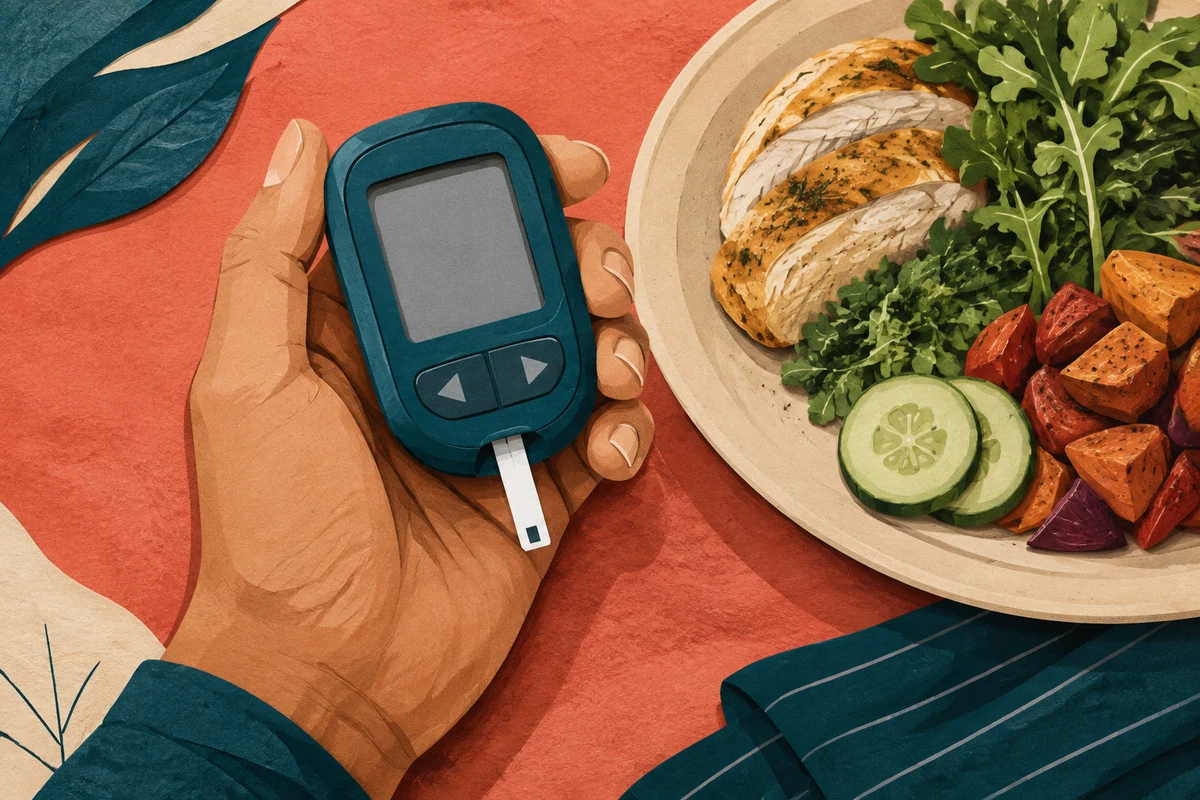
It may help a little, but the research does not give one consistent answer. Some pooled trials found lower fasting blood sugar; another review did not. Plain kefir can still fit into a meal, provided you count what is in the glass.
Why do the studies seem to disagree?
One review reports a lower blood-sugar result. Another finds no clear effect. Both can be reporting their analyses accurately: they may include different trials, products, participants and comparison drinks.
These are reviews of overlapping research, not three completely independent sets of people. Read the result beside the outcome it actually measured.
2026 is the journal-issue year (published online in 2025). HOMA-IR estimates insulin resistance; “no clear effect” means the result was not statistically significant.
| Review | Fasting blood sugar | Another finding that matters |
|---|---|---|
| 2021: six trials, 323 participants | About 10.3 mg/dL lower on average | No statistically clear reduction in HbA1c |
| 2023: six trials, 314 participants | No statistically clear effect | Insulin and HOMA-IR, an estimate of insulin resistance, improved |
| 2026: 24 intervention studies overall | About 8.5 mg/dL lower on average | HOMA-IR improved; not every study measured every outcome |
A difference of around 8 to 10 mg/dL is modest. It does not tell you what one person's meter will show after a glass, and it is not a promise that kefir will lower your HbA1c. HbA1c reflects a longer period than a single fasting measurement.
The useful conclusion is that there is a signal worth studying, with uncertainty about how reliably it carries over to everyday drinking. A positive insulin-resistance result also should not be described as proof that diabetes improved.
Start with the label, not the word “kefir”
Plain milk kefir still contains carbohydrate, usually including some lactose. Fruit-flavoured versions may have added sugar. Water kefir starts with sugar water; fermentation does not guarantee a sugar-free drink. Plant-based versions vary with the base and added ingredients.
For a first comparison, check total carbohydrate per serving, the ingredient list and whether the serving size matches your glass. Protein and the rest of the meal matter too. The label guide helps you work through the details.
A label says 4.8 g carbohydrate per 100 ml. How much is in a 200 ml glass?
9.6 g: multiply 4.8 by two. This is an illustrative label calculation, not the composition of every kefir. A large glass can contain more carbohydrate than the small number on the front suggests.
What is the kefir replacing?
Replacing a sweet drink with an unsweetened product may reduce the sugar in that meal. Adding kefir to everything you already planned to eat is a different change: it adds carbohydrate and energy.
The comparison should use your actual product and portion. A label that says “live cultures” does not answer these questions:
- What food or drink will it replace?
- How much total carbohydrate is in your portion?
- How does its protein fit with the rest of the meal?
- Do you enjoy it and tolerate it?
Prefer something savoury? An herb dressing uses kefir differently from a sweet drink. The portion and the food you serve it with still count.
Trying kefir without copying a study dose
An adult who tolerates the ingredients could begin with 60 to 120 ml alongside food. That is a practical tasting portion, not a dose proven to lower glucose. You do not need to work up to a large research serving.
If you already monitor glucose, follow the monitoring plan agreed with your clinician. Meals, activity, illness and medication can all affect a reading, so one change on the meter cannot show that kefir caused it. Do not change prescribed medication in response to a food experiment.
Notice digestion as well. If kefir repeatedly causes pain or diarrhoea, stop rather than increasing the amount. Feeling less bloated is welcome, but it does not establish that your blood sugar has improved.
What if milk is the problem?
Some people with lactose intolerance digest milk kefir more comfortably than milk, but the product can still contain lactose. A clearly labelled lactose-free product is another option if milk protein suits you.
Milk allergy is different. Milk kefir remains unsuitable because fermentation does not remove the milk proteins. A dairy-free product needs its own allergen and nutrition check. Research on milk kefir does not automatically establish the same glucose effect for soy, oat, coconut or water kefir.
Would a probiotic supplement be better?
A bigger microbe count cannot settle that question. A supplement would need evidence for its particular strain, dose and purpose; it cannot borrow a result from a different fermented-milk product.
Kefir can be chosen as a food you enjoy. A supplement is a separate decision, particularly when a clinician recommends one for a defined reason. Neither should replace prescribed diabetes care. The comparison guide explains what to look for.
If you decide to try it
Pick a product you would enjoy eating, check the carbohydrate in your portion and consider the whole meal. Keep your usual care in place. The research supports curiosity about kefir; it does not support a guaranteed glucose-lowering promise.
Sources and further reading
The 2023 review reporting no clear fasting-glucose or HbA1c effect is included alongside the positive pooled findings below.
- Systematic review and meta-analysis of glycemic control, PMID 34280689
- Systematic review and meta-analysis of metabolic outcomes, PMID 41076330
- Selected-organism fermented milk trial in type 2 diabetes, PMID 25905057
- NIDDK: The A1C test and diabetes
- Kefir consumption and health effects based on human clinical trials
- Controlled study of kefir and lactose digestion






Comments
No comments yet.
Comments could not be loaded.
Join the discussion