
A community you can hold
What is inside a kefir grain?
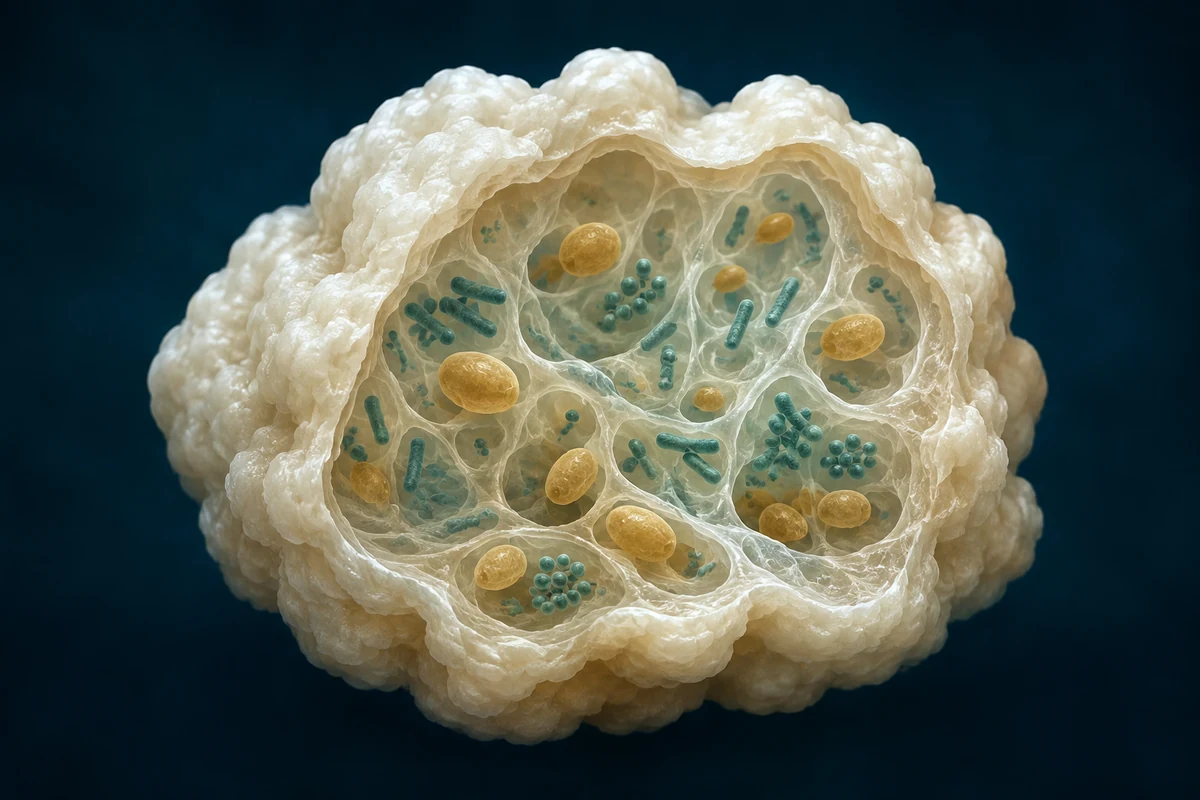
A milk-kefir grain looks like one small object, but some of its microbes depend on their neighbours to grow well in milk. The community can do things its members struggle to do alone. Inside the pale structure, bacteria and yeasts share a changing environment—and the drink they make is not simply a liquid copy of the grain.
Different jobs, shared fermentation
What each group adds to the community
Follow the community
Lactic acid bacteria make the milk tart
As they use sugars, these bacteria produce lactic acid. Falling pH helps milk proteins gather into a soft gel. The change you see in a jar is partly a change in the milk itself, not just more grain material.
Yeasts contribute gas and aroma
Yeasts can produce carbon dioxide, ethanol and aroma compounds. Their activity helps explain the gentle fizz some kefirs develop. The amount varies; neither bubbles nor taste measures the alcohol content.
Acetic acid bacteria can sharpen the profile
When present and given suitable conditions, they can produce acetic acid. They are one possible part of the ecosystem, not a guaranteed member of every culture.
The matrix holds the community together
Microbes live within and around material that helps give the grain its shape. In milk-kefir cultures, one relevant material is kefiran, a polysaccharide made by microbes. The whole matrix contains more than that one compound.
For a different view of grain structure, Lu and colleagues’ microscopy study includes electron micrographs with scale bars. These are prepared specimens, not the same observation method as the video below.
The grain and milk are connected communities
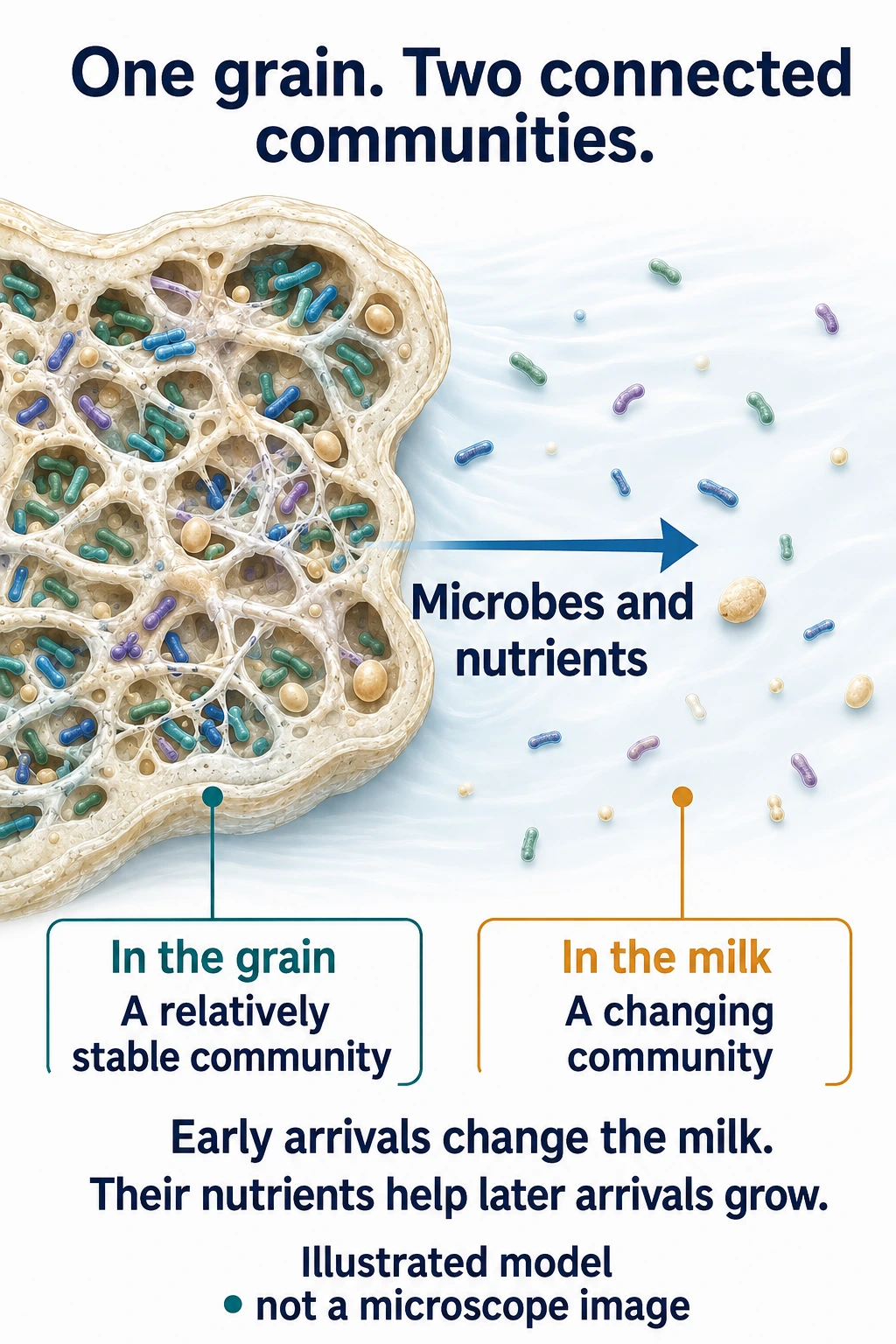
A 2021 study found a useful contrast: the grain community remained relatively stable while the milk was colonized in succession. Some microbes helped make nutrients available for those that followed. The interaction explains how members poorly suited to growing alone in milk can still belong to a successful kefir community.
Nutrient exchange
Lactobacillus
kefiranofaciens
↓ Amino acids + small peptides ↓
Leuconostoc
mesenteroides
↑ Lactate ↑
One partner releases amino acids and small peptides from milk protein. The other supplies lactate in return. In the tested pair, these exchanges support growth.
The study observed early growth of L. kefiranofaciens, followed by rapid growth of L. lactis and L. mesenteroides; L. kefiri and A. fabarum continued growing later. That sequence describes the studied culture, not a timetable for every home batch.

Microbehunter’s Oliver Kim compares a flattened grain with its surrounding liquid, then switches to phase contrast so individual cells become easier to see. This excerpt is microscopy, not a recipe or a test of whether kefir is safe to drink. English narration; YouTube offers automatically generated captions.
Open the original video at3:44The change at5:26 is an optical contrast change. Shapes alone do not identify strains or count every living organism.
Early arrivals change the milk
Microbes begin using available nutrients. Their activity changes the liquid, making it a different environment for the organisms that follow.
One microbe’s output can help another
The researchers identified exchanges involving nutrients such as amino acids and lactate. Fermentation is a community process, not simply several organisms consuming the same food independently.
Straining does not remove the whole culture
The drink contains microbes as well as the products of fermentation. Their proportions can differ from those in the grain. Follow the fermentation timeline for the visible changes that accompany the process.
A different structure in sugar water
Water-kefir grains are translucent clusters used with a suitable sugar-water recipe. Their supporting polysaccharide is mainly dextran. They are not milk grains with the dairy washed off. The milk-and-water comparison connects this difference with what you can make.
Sugar water becomes a working environment
The culture begins using the recipe’s sugars and producing acids, gas, aroma compounds, and grain material at different rates.
The recipe changes which members do well
Water source, sugar, minerals, fruit, handling, and culture history can shift the community and its output.
Similar jobs, variable communities
A 2025 study examined 69 water-kefir grain microbiomes and found shared features alongside variation. One species list cannot describe every grain. Culture history and the recipe still matter when you follow a water-kefir method.
Why two healthy cultures can differ
Can a picture tell you how many microbes are in your glass?
No. This illustration explains roles and relationships. It does not show the organisms, proportions or live count in a particular serving. DNA sequencing can identify biological material, but ordinary sequencing alone does not establish a living dose or a health effect. The CFU guide explains the difference.
Can I recreate a grain just by mixing the species named in a study?
A species list is not a grain-making recipe. Community organisation, interactions and growth conditions matter too. For a home batch, begin with an established culture or an appropriate starter, and follow its method.
Sources behind this explanation
- Analysis of the milk kefir pan-metagenome reveals four community types, core species, and associated metabolic pathwaysiScience, 2023
- Metabolic cooperation and spatiotemporal niche partitioning in a kefir microbial communityNature Microbiology, 2021
- Microbial Succession and Flavor Production in the Fermented Dairy Beverage KefirmSystems, 2016
- The core microbiomes and associated metabolic potential of water kefir as revealed by pan multi-omicsCommunications Biology, 2025