
What is kefiran?
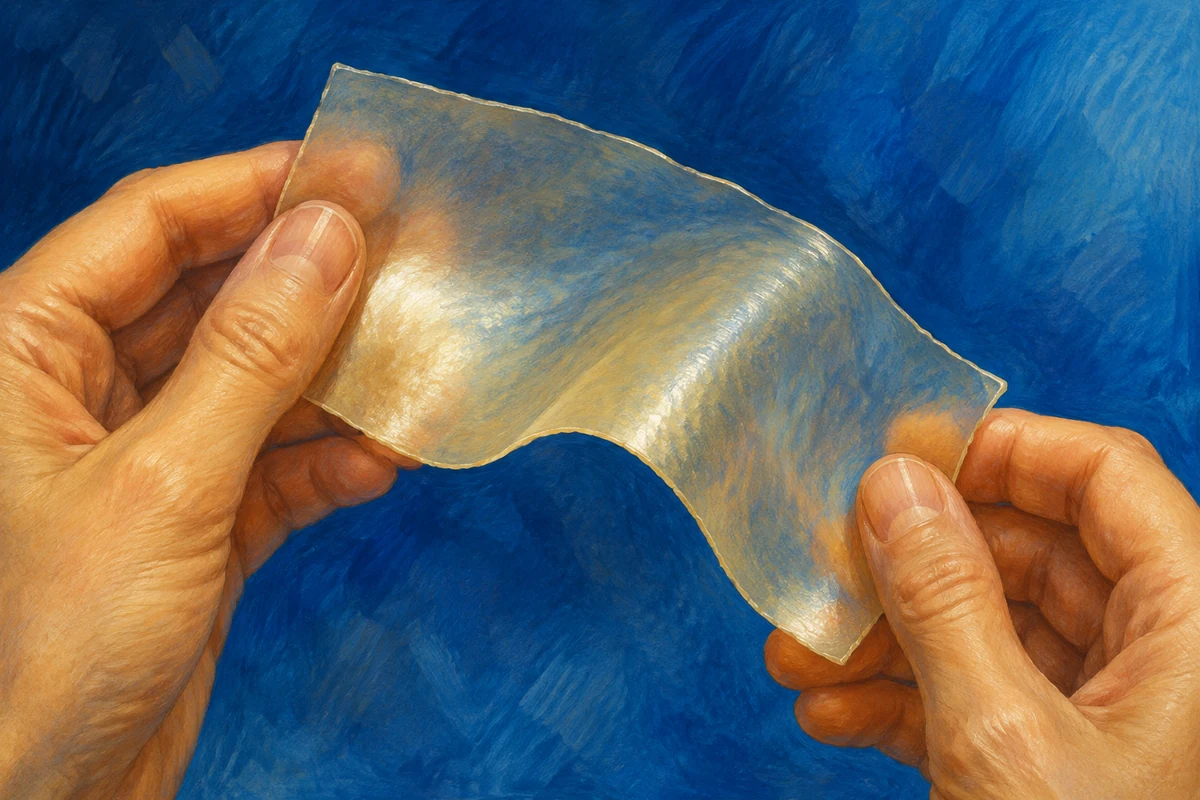
A kefir grain holds together even when you strain it out of the milk. Part of that structure comes from material made by its microbes. Kefiran is one of those materials: a long carbohydrate molecule, or polysaccharide. Researchers can separate it from milk-kefir cultures and make thin films from it—a surprising next use for something that begins in a fermentation jar.
Two words explain what it is
Microbes produce this material outside their cells. It helps form the surroundings in which the community lives.
Many sugar units join to form one long molecule. Kefiran contains glucose and galactose units; it is not a protein or a living bacterium.
How does grain material become a film?
Separating a compound, forming a film and making a useful package are different steps.

The grain contains more than kefiran
A milk-kefir grain contains microbes, water, proteins and other material as well as polysaccharides. Kefiran is part of this structure. It is not another name for the entire grain or everything in the drink.
Look inside the grain community to see how the microbes and their surroundings fit together.
Separate the material you want to study
Researchers extract and purify kefiran so they can examine a more defined sample. That makes it possible to ask what this compound does. The resulting sample is different from a whole grain or a glass of kefir.
The extraction method and remaining ingredients affect the material. A study using purified kefiran cannot automatically describe an ordinary fermented drink.
Cast it into a thin layer
In a 2011 film study, researchers prepared kefiran films by casting a liquid mixture and allowing the solvent to evaporate. They varied glycerol, an ingredient used to alter flexibility, and measured the resulting material.
The films' mechanical and thermal properties changed with the formulation. The interesting result is a material whose behaviour can be adjusted, not a ready-made replacement for every plastic.
A wrapper has to do a job
A film that holds together on a laboratory plate still has to survive handling, humidity and contact with the food it might wrap. It needs testing for that actual use. Flexibility is useful, but it does not tell us whether the material will keep moisture out or remain suitable during storage.
Why add glycerol?
A thin film can be too brittle to bend or too sticky to handle. Glycerol is a plasticizer: an ingredient that changes how the material moves and feels. The amount matters, which is why researchers compare formulations rather than judging a film from a photograph.
Purified kefiran, with different glycerol amounts
The experiment changed the formulation while examining the resulting film. It was not a test of pouring ordinary kefir into a tray.
How the film bends, stretches and responds to heat
These measurements describe the material in the experiment. They do not measure a benefit from drinking kefir.
Whole grain material behaves differently
A 2024 study compared materials made from whole milk-kefir grain biomass with purified kefiran. Their properties differed. Keeping more of the original grain changes the material; purification is not just a new name for the same thing.
What can you tell from a jar?
A thick or stringy batch cannot tell you how much kefiran it contains. The amount needs laboratory measurement, just as a glass cannot reveal its live-microbe count. If the texture changed unexpectedly, start with the contamination checks in the texture guide.
What would make a film useful as packaging?
A dry cracker needs protection from moisture to stay crisp; a moist food may hydrate or soften the film in contact with it. The film also needs to resist handling and remain suitable at the intended storage temperature and duration. These are different packaging jobs, so one promising film cannot be assumed to suit both.
For either use, researchers still need to assess the formulation, thickness, consistency of production, seal and food-contact suitability. The food ingredients can change the material’s behaviour. These are requirements to test, not properties established for every kefiran film.
Sources
The film studies examine materials. They do not establish a treatment benefit from drinking kefir or applying it to skin.
Open the sourcesStudy details and definitions
- Standard for Fermented Milks, CXS 243-2003Codex Alimentarius Commission, amended 2024
- Development and characterisation of a new biodegradable edible film made from kefiranFood Chemistry, 2011
- Laboratory and animal research record for kefir and isolated kefiranInternational Journal of Antimicrobial Agents, 2005
Go back to the living grain
The material is only part of the story. See how bacteria and yeasts share a grain and change the milk around it.