
Where did milk kefir come from?
Milk kefir has a long tradition in the North Caucasus. Yet one of its oldest surviving clues comes from much farther east: cheese preserved in a Bronze Age cemetery in Xinjiang. Neither story identifies the first grain.
The landscape, ancient dairy and printed records let us follow different parts of that history—and see where the evidence runs out.

Where these records come from
Two regional views, thousands of kilometres apart. They locate evidence; they do not show a proven journey from one place to the other.
1 · North Caucasus
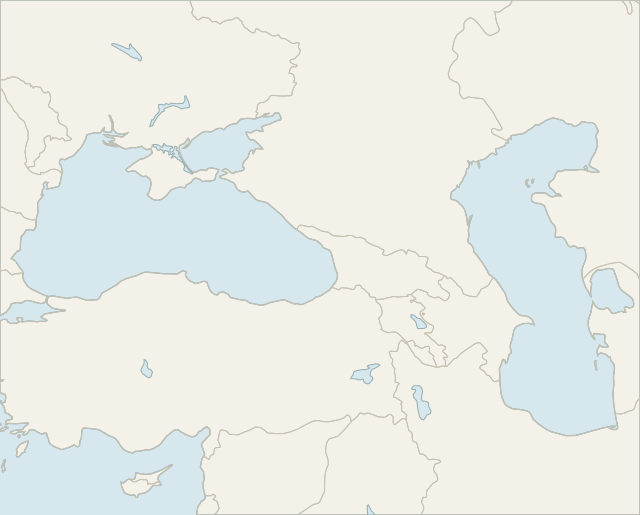
The mountain region between the Black and Caspian seas. Follow its household tradition.
Read this chapter2 · Xiaohe, Xinjiang
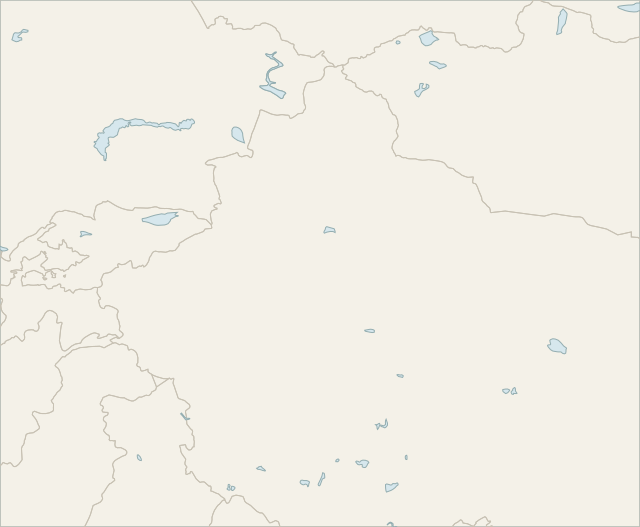
A cemetery in the Tarim Basin preserves ancient dairy remains. Read what scientists found.
Read this chapterNorth is up. Coastlines and modern boundaries are simplified; the North Caucasus marker identifies a region, not a single birthplace.
Ancient cheese preserves a microbial story
Dairy remains from Xiaohe cemetery in Xinjiang gave researchers something unusually direct to examine. A 2014 study used proteins to identify kefir cheese; a 2024 study recovered ancient DNA from roughly 3,500-year-old cheese.
The DNA research found evidence for an additional route of kefir spread from Xinjiang into inland East Asia. That makes the history wider than a single journey from the Caucasus to Europe. It does not trace the ancestry of every modern grain.
The two dates belong to the research, not the cheese: proteins were examined in 2014; ancient microbial DNA was reported in 2024. Read the DNA study.
A culture that could be shared
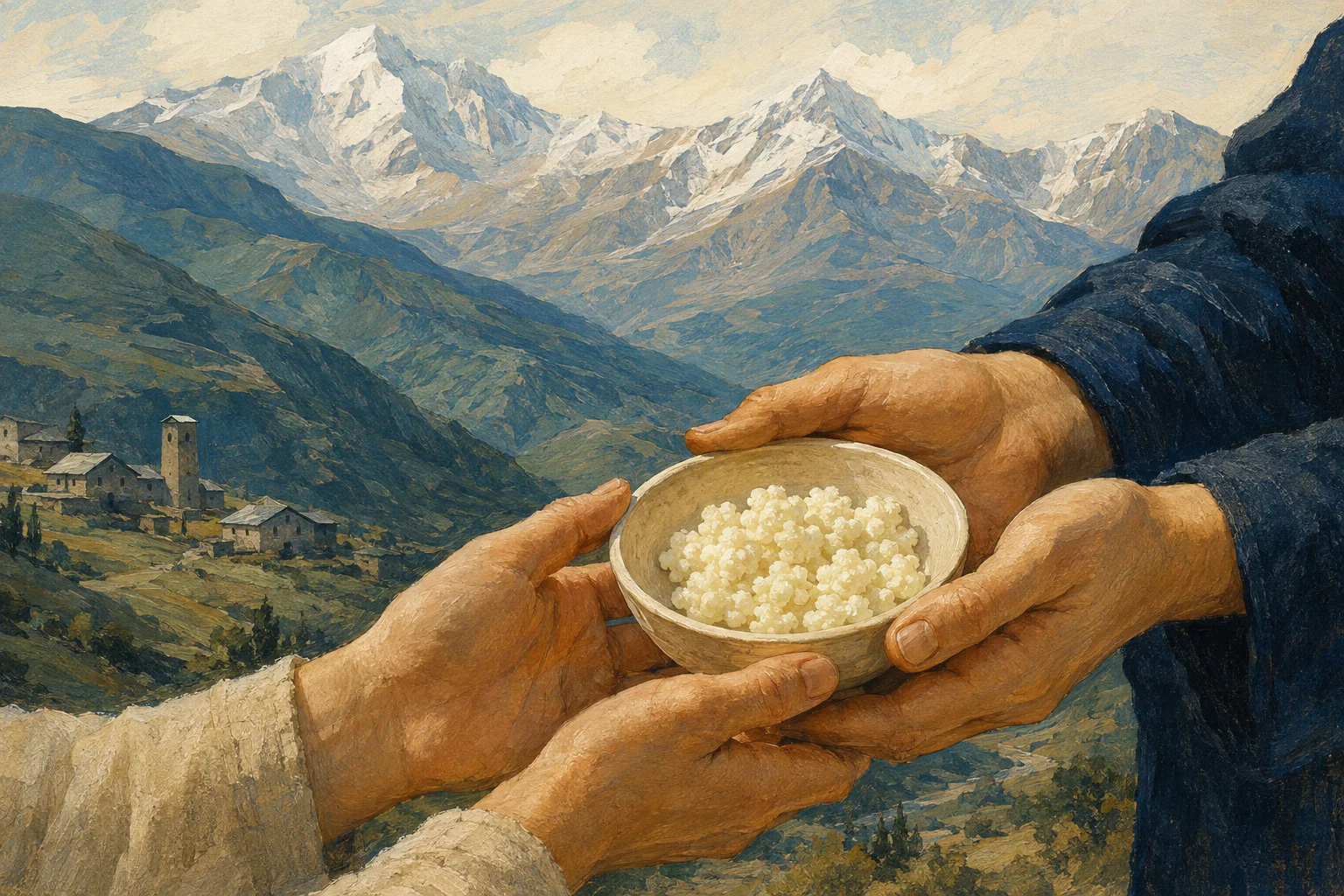
In the North Caucasus tradition, making kefir depended on keeping the grains for another batch. Sharing some grains also shared the means to make the drink. Accounts describe household fermentation and animal-skin containers, long before a refrigerated bottle became familiar.
The same practical distinction survives today: a glass of kefir is the finished food; the grains hold the community used to ferment more. Their value helps explain why so many stories surround giving them away.
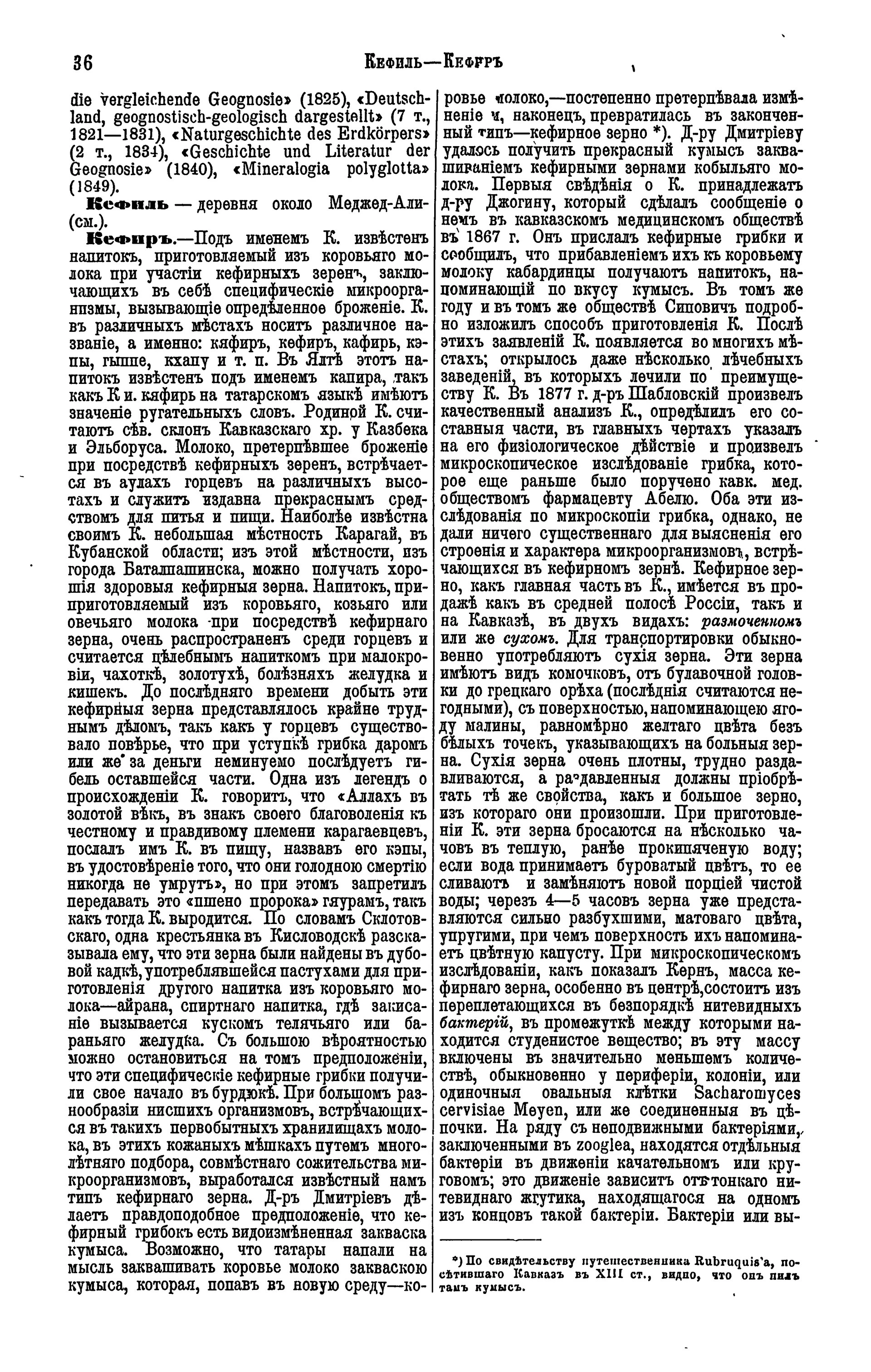
Kefir reaches medical writing and larger production
The 1895 Brockhaus and Efron encyclopedia traced a report to the Caucasian Medical Society in 1867. A later regional review records Russian mass production beginning in 1908, initially supplying hospitals.
That history explains one route by which a regional food reached a wider public. Its historical medical reputation is a separate question from what human studies show about drinking kefir today.
A few dates, with a very long gap
- About 3,500 years agoDairy remains at Xiaohe
- Long gap in the surviving record · spacing is not to scale
- 1867A medical-society report, cited in 1895
- 1895The encyclopedia entry you can inspect below
- 1908Russian mass production, dated by a later review
The reusable culture travels
Home making continued alongside commercial production as kefir spread beyond the Caucasus. Grains could be passed from one maker to another; dairies developed ways to prepare larger starters and produce a more consistent bottle.
A familiar food now comes from several culture systems. Follow the modern production line to see where grains may fit into the process—and why they are not floating in the finished bottle.
How did the first grain form?
A stable grain is a microbial community with a structure, not simply milk that has turned sour. Its deeper evolutionary origin remains unresolved. Ancient cheese tells us fermentation was happening at a particular place and time; later traditions show people maintaining and sharing cultures. Neither gives us a record of the first grain forming.
Why older books use different names
You may meet the same drink under a different spelling. Names help connect the records, although a name alone cannot identify a culture’s birthplace.
The modern Russian spelling and the final hard sign visible in the 1895 printed heading. See the original type above.
You can still find this spelling in English dairy references and historical writing.
The review records this name in its discussion of local kefir traditions. Historical names reflect the language and spelling of the source in which they appear.
Research behind this history
Read the archaeological studies, historical entry and dairy references discussed above.
Read the sourcesArchaeology, history and dairy references
-
Bronze Age cheese reveals human-Lactobacillus interactions over evolutionary historyOpen source
Yichen Liu et al., Cell, 2024
-
Proteomics evidence for kefir dairy in Early Bronze Age ChinaOpen source
Yimin Yang et al., Journal of Archaeological Science, 2014
-
KefirOpen source
V. Ignatiev, Brockhaus and Efron Encyclopedic Dictionary, 1895
-
Kefir revisited: Insights from the North CaucasusOpen source
Palina Kh. Katchieva et al., World Journal of Experimental Medicine, 2025
-
Milk and dairy products in human nutritionOpen source
Food and Agriculture Organization, FAO, 2013
-
Etymological Dictionary of the Ukrainian Language, volume 2Open source
O. S. Melnychuk et al., Naukova Dumka, 1985
Water kefir has a different trail
Its older records take us to British ginger-beer plant and Mexican tibi, with an unexpected cactus connection.