
Measure fermentation
How to use a pH meter for kefir
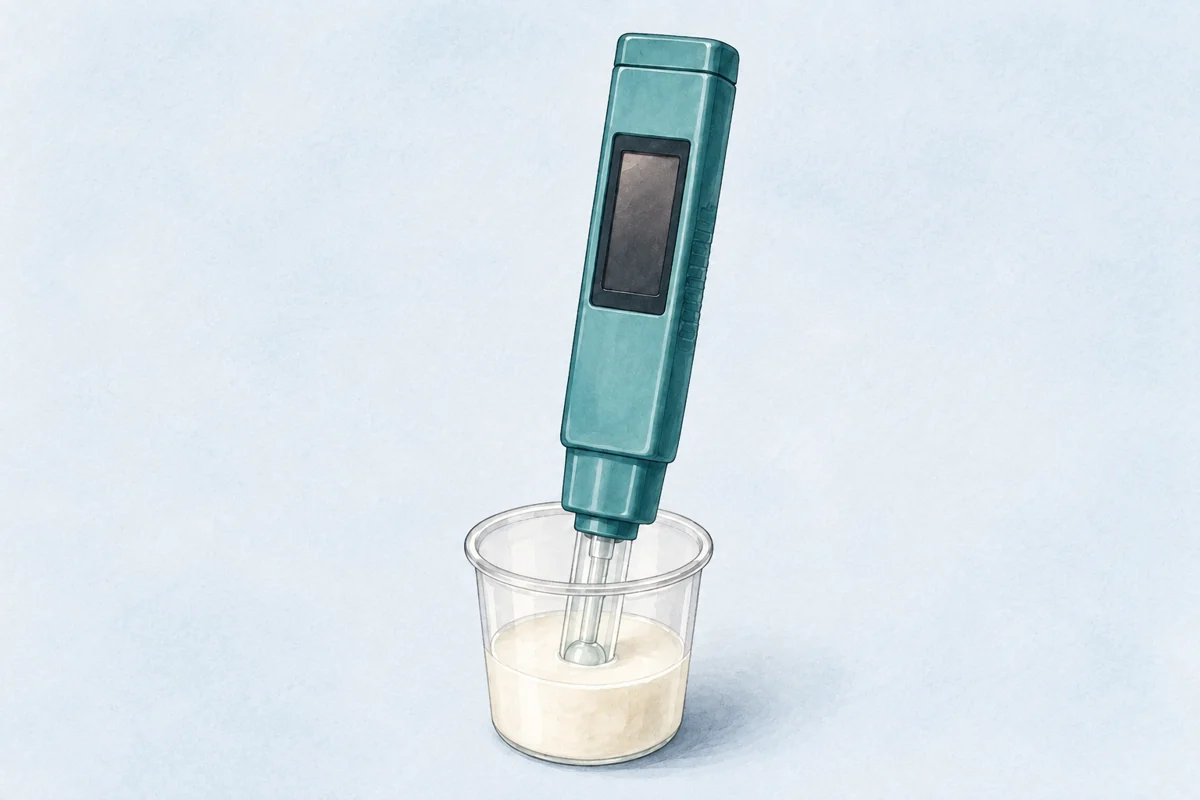
A pH meter tells you whether acids are building; it does not tell you that a batch is automatically safe. Calibrate with fresh pH 4 and 7 buffers, mix the kefir gently, take three clean samples, and record the average. Nothing that touches the electrode goes back into the jar.
What does the number tell you?
A falling pH shows that the mixture is becoming more acidic. It can help distinguish a slowly developing ferment from one that has stalled. It cannot identify microbes, measure alcohol, detect every toxin or reconstruct an unknown storage history.
For milk kefir, combine readings with the method’s time limit: a batch that has not reached pH 4.6 or less within 36 hours has failed. With water kefir, some starting mixtures are already acidic, so use the verified recipe’s additional process checks. The two fermentation paths explain why the same number can mean different things.
Calibrate before measuring
Use a meter intended for food, with accuracy suitable for the decision. A display showing two decimal places is not proof of that accuracy. Follow the manufacturer’s two-point calibration procedure with fresh pH 7 and pH 4 buffers in the specified order.
Pour small buffer portions into separate clean cups. Do not dip the probe into the stock bottles. Rinse as directed between buffers and samples, and use the correct electrode storage solution. A dry, dirty or damaged electrode needs attention before its readings can be trusted.
Take separate samples
Gently mix the plain kefir. Use clean utensils to take three representative samples into separate cups, with enough liquid to cover the electrode as instructed. Measure at the instrument’s recommended temperature, waiting for each reading to stabilize. Keep the main batch’s handling time short.
Record all three results, plus time, temperature and recipe. Discard tested samples; do not drink them or return them to the jar. This procedure follows the University of Minnesota’s food pH guidance.
The readings fall on both sides of 4.6. Should I average them?
Do not use an average to dismiss a reading above the decision limit. Check calibration, sample mixing and the meter’s stated accuracy, then take fresh samples. An unresolved result near the limit does not confirm that the batch passed. For milk kefir, keep the original fermentation start time; retesting does not restart the 36-hour limit.

Read the measuring steps
- Calibrate with fresh pH 4 and 7 buffers, in your meter’s specified order.
- Mix gently and prepare three separate samples. Never dip the electrode into the original batch.
- Rinse between measurements and wait for each reading to settle.
- Record every reading. Discard the tested samples.
Compare readings you can trust
Closely agreeing readings can be recorded with their average for comparison. Widely separated readings need a method check, not selective deletion. Save the original values too. The four-batch journal provides a place to connect measurements with the change you are testing.
Same average. Different story.
Both examples average 4.40. Switch between them to see what that single number leaves out.
Illustrative values—not measurements of real kefir or a safety verdict.
The readings agree closely
Average 4.40
Close agreement is useful, but it cannot reveal a meter that was calibrated incorrectly. Keep the original readings, time and temperature.
The readings are spread out
Average 4.40
The average stays the same while the spread grows. Check calibration, mixing and meter accuracy, then take fresh samples. Do not delete a high reading to make the average look better.
A low pH does not rescue a contaminated batch
Mould, unusual colour, insects, rotten or chemical odour, a damaged container, or an unknown handling history still means discard. Do not use one acceptable reading to argue with a direct warning sign.
What the meter still leaves unanswered
Are pH strips enough?
They can show a broad range, but they are not suitable when the decision needs a precise endpoint. Use a calibrated food pH meter for that job.
Why does the reading keep drifting?
Temperature, a dirty or dry electrode, weak calibration, carbon dioxide, and an unmixed sample can all cause drift. Check the method before blaming the kefir.
Can pH tell me how much alcohol is present?
No. Acidity and alcohol are different measurements. An exact alcohol question requires a suitable test of that exact batch.
Research behind this answer
Where to go next


Comments
No comments yet.
Comments could not be loaded.
Join the discussion