
Fermentation Craft · Kefir Guide
1-Day vs. 3-Day Kefir: How Fermentation Age Changes Tang, Texture, Digestion & Kitchen Uses
In traditional Russian kitchens, a single jar of milk kefir transforms dramatically over three days: gentle 1-day kefir pours silky and soft for sensitive stomachs, 2-day kefir gives you the bright everyday glass, and 3-day kefir develops a sparkling lactic zing that makes pancakes soar and homemade kefir cheese taste extraordinary.
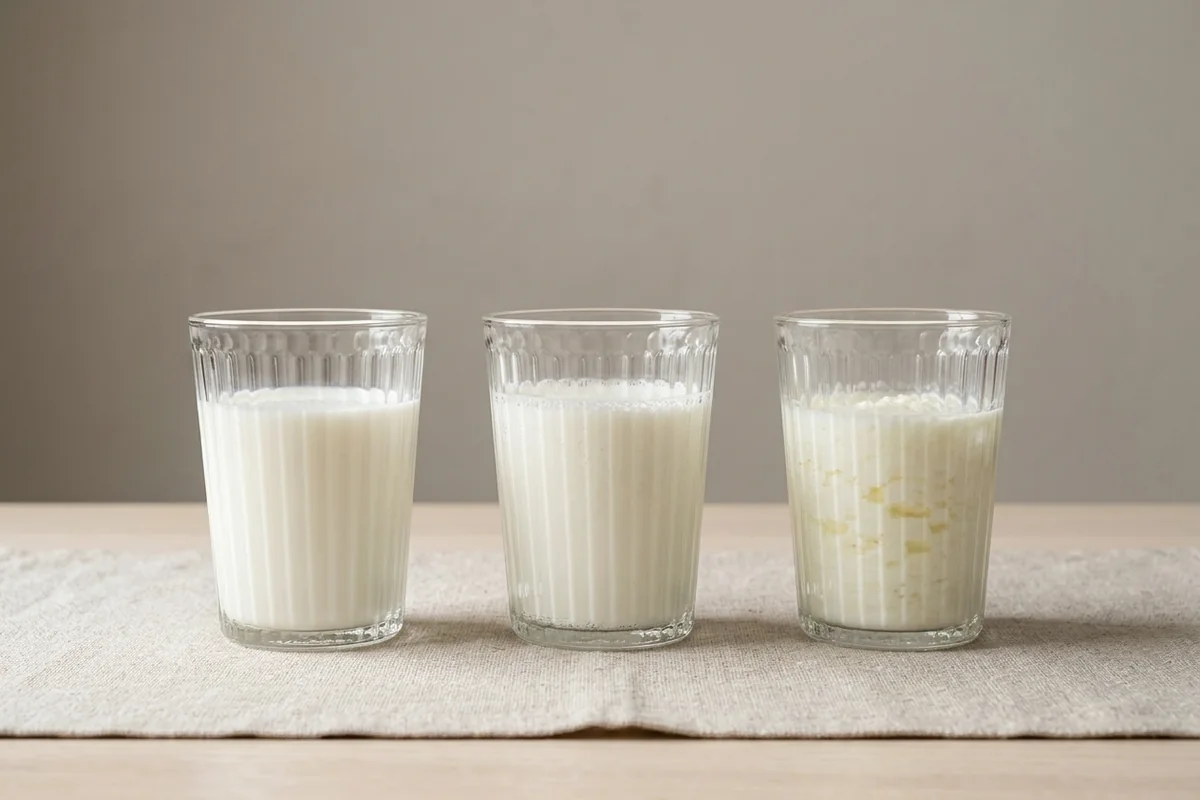
As kefir ages from Day 1 to Day 3, friendly bacteria and yeasts keep turning milk sugar into lactic acid, soft curds, and gentle natural fizz. Choose mild 1-day kefir if you want a creamy, soothing sip or a gentle boost for constipation, enjoy 2-day kefir as your everyday breakfast pour, and save tangy 3-day kefir for recipes, lower-lactose sipping, or fresh kefir cheese.
One crucial kitchen trick for warm weather: strain your grains out at the 1-day stage, then let the finished kefir age safely in the fridge for Day 2 and Day 3.
Why the age of your kefir changes everything in the glass
Have you ever noticed that a freshly strained bottle of kefir tastes softly sweet and velvety like cultured buttermilk, while a bottle tucked in the back of the fridge for two more days turns crisp, thick, and lightly effervescent on your tongue? You didn’t imagine it—and you didn’t make a mistake!
In Russia and Eastern Europe, where home fermenters have poured milk kefir for generations, people don’t treat kefir as one fixed flavor. Instead, classic household wisdom divides kefir by age into three distinct personalities: 1-day (однодневный, or mild), 2-day (двухдневный, or medium), and 3-day (трехдневный, or mature). Learning to recognize all three lets you tune every jar to match both your taste buds and your stomach.

The Russian 24h / 48h / 72h tradition, explained for your kitchen
Traditionally, milk kefir was bottled and dated so families knew exactly what kind of comfort waited inside:
- 1-Day Kefir (однодневный — Mild, ~24 hours): Just finished primary fermentation. The curds are loose and velvety, the taste is subtly tart-sweet (around pH 4.5–4.6), and yeast activity is still quiet, leaving very little carbonation and only minimal trace fermentation alcohol (typically around 0.1–0.2%). In Russian dietary custom, fresh 1-day kefir is famous as the gentle choice for easing constipation and soothing delicate tummies.
- 2-Day Kefir (двухдневный — Balanced, ~48 hours): After another day of cool resting, lactic acid bacteria have lowered lactose further, proteins have set into a lush, pourable yogurt-drink consistency, and a tiny tingle of natural carbon dioxide appears. Most everyday kefir drinkers fall in love with this sweet spot.
- 3-Day Kefir (трехдневный — Mature, ~72 hours): Now kefir develops its grown-up character. Acidity deepens (often settling closer to pH 4.1–4.3), milk proteins tighten into thicker curds with small ribbons of clear golden whey, and yeasts create gentle sparkle alongside slightly higher trace ethanol (around 0.4–0.6%—still far below standard non-alcoholic limits in most foods, though worth knowing if you avoid every drop of trace alcohol). Classic Russian wellness guides traditionally consider 3-day kefir more “firming” or astringent in the gut—and home cooks treasure it for baking and draining into soft cheese!
What changes inside the bottle from Day 1 to Day 3
In one clear summary: as kefir matures from 24 to 72 hours, its living lactic acid bacteria and yeasts continue gently snacking on milk lactose—reducing remaining lactose even further (Hertzler & Clancy, 2003)—while steadily releasing lactic acid, organic flavor compounds, peptides, carbon dioxide, and tiny trace amounts of yeast ethanol (Leite et al., 2013; Güzel-Seydim et al., 2000; Rosa et al., 2017; Bourrie et al., 2016). Meanwhile, on bowel habits, traditional Russian practice pairs mild 1-day kefir with gentle regularity and views sharp 3-day kefir as firmer; in modern clinical research, a 4-week study of adults with chronic constipation (Turan et al., 2014) found daily cultured milk kefir helped soften hard stools overall, so letting your own stomach’s comfort guide which day feels best is always smartest.
Visual Guide: How Milk Kefir Evolves Across 24, 48 & 72 Hours
Watch pH, lactose, lactic tang, fizz, and best kitchen uses shift smoothly from Day 1 to Day 3.

How to make 1-day, 2-day, and 3-day kefir safely in Taiwan’s warm kitchens
Here is the single biggest mistake beginners make when reading European or North American kefir guides: never leave your living kefir grains sitting in the same milk on a 28–33°C Taiwan kitchen counter for 48 or 72 hours!
In cool 18–21°C Russian or Northern European kitchens, fermentation ambles along gently. In warm, humid Taipei, Taichung, or Kaohsiung summers, kefir grains work much faster—often turning fresh milk creamy within 10 to 16 hours! Leaving grains in already-acidified milk for three warm days starves the grains, splits the jar into rubbery curds and sour whey, and wears out your culture.
Instead, follow this joyful two-stage refrigerator rhythm:
- Make 1-day kefir with the grains (12–24 hours at room temp): Ferment until the milk thickens smoothly and coats the glass when tilted, smelling gently yeasty and fresh like sweet cream and yogurt. Immediately strain out your kefir grains into fresh milk. Drink right away for ultra-mild 1-day kefir!
- Bottle and chill for 2-day kefir (24 hours in the fridge): Pour your strained kefir into a clean glass bottle (leave a couple centimeters of headspace), cap it, and refrigerate at around 4°C. The cold slows fermentation down gently, mellowing any sharp edges into velvety 2-day kefir by tomorrow morning.
- Rest one more day for 3-day kefir (48 hours in the fridge): By the third day, those patient cold-tolerant microbes deepen the lactic tang, create tiny natural bubbles, and make the texture extra lush—with zero stress on your grains! Want extra fruit flavor or fizz faster? Explore milk kefir second fermentation.
Quick Kitchen Selector
Which kefir age matches your stomach and recipe today?
Tap what you’re looking for right now to pick the ideal fermentation age.
Pour mild 1-day kefir with oats, kiwi, or guava
Freshly strained 1-day kefir sits lightly on the tummy, pours smoothly without excessive sour bite, and echoes the classic Russian habit of pairing mild 24-hour kefir with sluggish bowels. Team 100–150 ml with breakfast fiber and water—read our full constipation guide.
Chill strained kefir 24 hours for your sweetest spot
One day of cold conditioning rounds out the flavor into a bright, creamy dream—thick enough to spoon over berries, fluid enough to drink effortlessly from a glass, and lovely whether you pour it in the morning or early evening.
More fermentation time means less leftover lactose
As kefir rests into Day 2 and Day 3, microbes keep nibbling through residual lactose. Start with 60–100 ml alongside food—and remember, if you have active acid reflux or gastritis, gentle 1-day kefir will feel much kinder than tangy 3-day kefir.
Your secret weapon for fluffy oladi & silky kefir cheese
Don’t worry if a bottle turns extra zippy by Day 3! Its rich lactic acid reacts with baking soda for sky-high fluffy kefir oladi pancakes, or strains effortlessly through cheesecloth into creamy homemade kefir cheese and tvorog.
Side-by-side comparison: 1-day vs. 2-day vs. 3-day kefir
| Stage | How to Make in Taiwan | Taste & Typical pH | Digestion & Trace Alcohol | Favorite Kitchen Uses |
|---|---|---|---|---|
| 1-Day (Mild) | 12–24 hrs with grains at room temp; strain & chill | Soft creamy tartness (~pH 4.5–4.6) | Gentlest on stomach & reflux; ~0.1–0.2% trace ethanol | Straight sipping, kids’ fruit bowls, overnight oats |
| 2-Day (Balanced) | Strain grains at Day 1, refrigerate 24 hrs | Bright yogurt tang, light tingle (~pH 4.3–4.4) | Lower lactose, smooth everyday digestibility (~0.2–0.4%) | Daily glasses, berry smoothies, salad dressings |
| 3-Day (Mature) | Strain grains at Day 1, refrigerate 48 hrs | Sharp lactic bite, fizzy, thicker curds (~pH 4.0–4.3) | Lowest lactose, firmer feel; ~0.4–0.6% trace ethanol | Oladi, waffles, biscuits, straining into tvorog/labneh |
When kefir gets even older than 3 days (Day 4 to Day 14)
What if you lose track of a bottle behind the milk carton and find it 7 or 10 days later? Relax—properly refrigerated homemade kefir doesn’t turn dangerous overnight just because whey separates! Look and smell calmly: if you see zero fuzzy mold on the rim and it smells briskly sour like buttermilk or sourdough starter rather than putrid or soapy, it has simply matured past drinking age into baker’s kefir.
Use 4- to 10-day kefir to tenderize chicken marinades, leaven biscuits and soda bread, or whisk into tangy herbed kefir spreads. Check our shelf-life guide or overly sour kefir fixes if you ever want to dial future batches back to gentler 1-day silkiness.
Curious about pH numbers? Totally optional!
You never need lab tools to tell 1-day from 3-day kefir—your eyes, nose, and spoon tell you everything immediately. Still, if you love kitchen gadgets and want to track how fast your jar shifts between seasons, explore our friendly pH meter guide for curious fermenters.
Frequently Asked Questions
Is 1-day kefir really better for constipation than 3-day kefir?
In classic Russian culinary and medical tradition, mild 1-day kefir is preferred for gentle bowel regularity while tangy 3-day kefir is considered firmer. Modern research shows daily milk kefir over 4 weeks softens stools overall—so starting with silky 1-day kefir alongside oats, fruit, and water is wonderfully comfortable on the stomach.
Should I leave kefir grains in the jar for 3 days to make 3-day kefir?
No—especially not in warm climates like Taiwan! Strain your grains out as soon as primary fermentation finishes (around 12–24 hours), move the grains into fresh milk, and let the strained bottle rest in the fridge for another 24 to 48 hours to develop 2-day and 3-day character safely.
Why does 3-day kefir look separated with yellow liquid?
As lactic acid rises over days 2 and 3, milk casein proteins gently tighten and release clear golden whey. That separation is completely natural—simply give the bottle a gentle shake before pouring, or ladle off the curds through a cloth to make creamy kefir cheese!
Does 3-day kefir have noticeably more alcohol than 1-day kefir?
Both stay very low, though yeast activity does nudge trace ethanol slightly higher over 72 hours (typically from around 0.1–0.2% on Day 1 up toward 0.5–0.6% by Day 3, depending on yeast balance and fridge time). If you are pregnant, serving toddlers, or avoiding every trace of fermentation alcohol, fresh mild 1-day milk kefir is your best pick.
What is the best thing to do if my kefir got too sour on Day 3?
Turn that bold tang into kitchen magic! Blend it with sweet ripe mango or banana, bake fluffy pancakes or scones, marinate chicken, or strain out the whey overnight in the fridge to create rich, mild kefir cream cheese and tvorog.
Sources
- Turan I, et al. (2014). Effects of a kefir supplement on symptoms, colonic transit, and bowel satisfaction in patients with chronic constipation. Turk J Gastroenterol (PMID 25599776)
- Leite AM, et al. (2013). Microbiological and chemical characteristics of Brazilian kefir during fermentation and storage processes. J Dairy Sci (PMID 23628252)
- Güzel-Seydim Z, Seydim AC, Greene AK. (2000). Organic acids and volatile flavor components evolved during refrigerated storage of kefir. J Dairy Sci (PMID 10714860)
- Rosa DD, et al. (2017). Milk kefir: nutritional, microbiological and health benefits. Nutr Res Rev (PMID 28222814)
- Bourrie BCT, Willing BP, Cotter PD. (2016). The Microbiota and Health Promoting Characteristics of the Fermented Beverage Kefir. Front Microbiol (PMID 27199969)
- Hertzler SR, Clancy SM. (2003). Kefir improves lactose digestion and tolerance in adults with lactose maldigestion. J Am Diet Assoc (PMID 12728216)