
Choose and drink
Homemade or store-bought kefir?
The biggest difference may be what happens tomorrow. A bottle is ready when you want it; reusable grains will need another feed. Making kefir gives you control over the ingredients and fermentation, while buying it saves that work. Neither choice guarantees more live microbes or a greater health benefit.
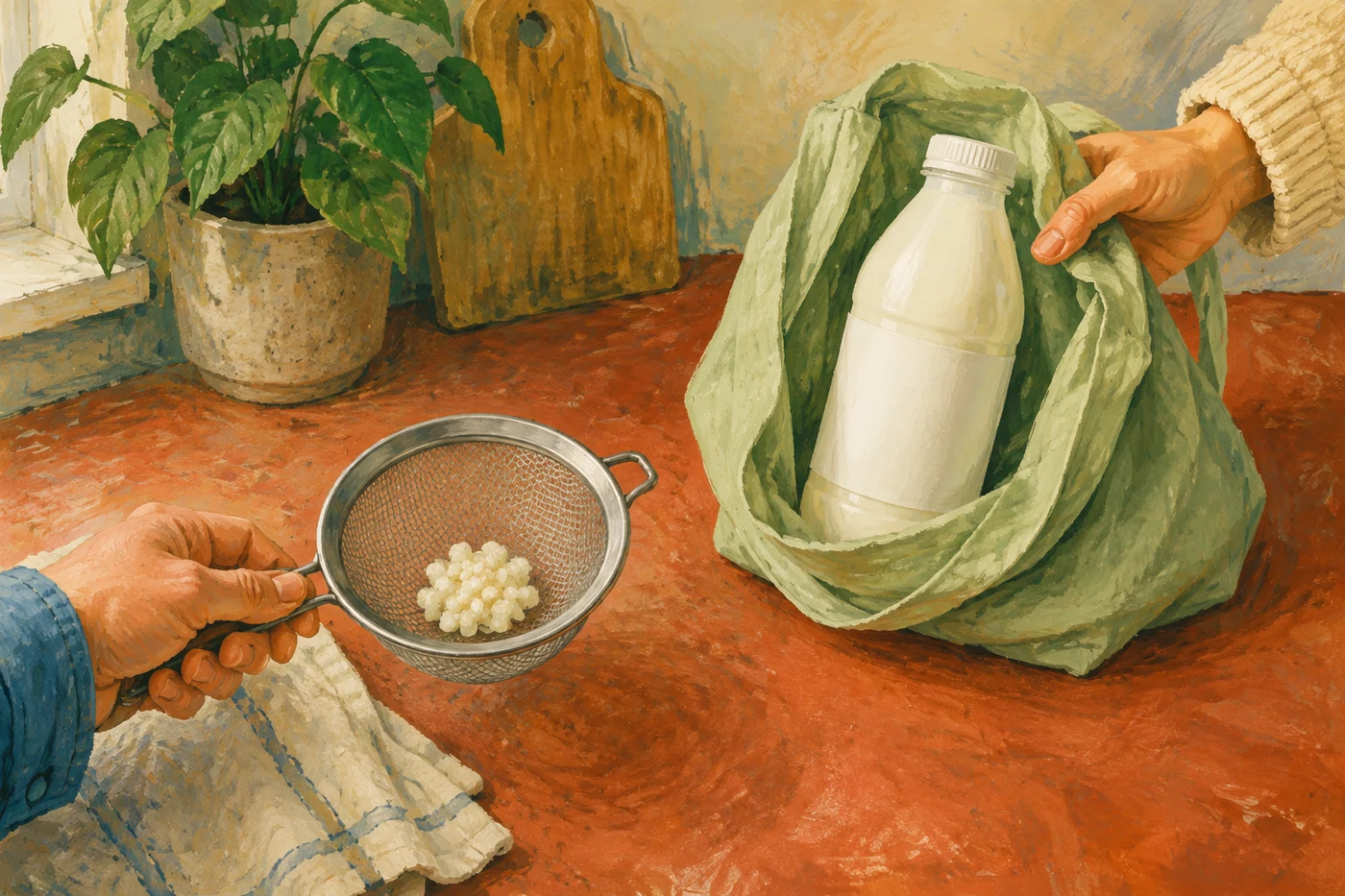
Compare the food and the work
The routine is part of the choice. Compare what you would do between servings, then read the actual ingredients and culture information for either option.
| What changes? | Making with reusable grains | Buying ready-made |
|---|---|---|
| Between servings | Ferment each batch, strain the grains and feed them again. | Open and serve; follow the product’s storage and after-opening directions. |
| Taste and ingredients | Choose the milk and adjust a sound fermentation routine. | Choose the flavour and ingredient list that suit your meals. |
| When you take a break | Arrange suitable storage or someone to care for the grains. | Follow the package’s storage instructions and printed date. |
A home jar can begin with grains or powder
With active milk-kefir grains, you ferment the milk, strain out the grains and feed them again. That reusable culture is a reason to make kefir at home. A direct-set starter gives you selected organisms in a measured packet; its instructions tell you whether any reuse is allowed.
Commercial producers can also use different culture systems. Some prepare a larger starter from grains; others use selected cultures for a repeatable result. If the method matters to you, look for an explicit statement. “Homemade” does not identify it.
A refrigerated bottle can still contain live cultures
Heating the milk before adding the starter prepares it for fermentation. Heating the drink afterwards can inactivate those cultures. The commercial-production guide shows where these two steps fit.
Look for a finished-product live-culture statement and follow the storage directions. “Fermented” alone does not answer whether living cultures remain when you drink it. A home batch also changes during storage; there is no reliable microbe count to calculate from its age or sourness.
What homemade kefir lets you change
You can choose the milk, adjust a sound fermentation routine and strain the drink at a taste and texture you enjoy. That does not mean every adjustment is safe. Use pasteurized milk, clean equipment and a reliable method, then refrigerate the finished drink promptly. Keep contamination and failed-fermentation signs separate from ordinary changes in thickness.
The culture responds to your kitchen. Warm weather can make a familiar batch finish sooner; growing grains can change the grain-to-milk ratio. If this sounds interesting, the temperature and ratio guide explains what to observe. If it sounds like one task too many, you can still enjoy kefir from a bottle.
Compare the same kind of drink
A homemade water kefir and a shop-bought milk kefir begin with different ingredients. Water kefir is not a replacement for milk's protein and calcium. Cultured soy, oat and coconut products also vary, including any added nutrients. Compare the actual labels when choosing something to replace milk or yogurt.
For milk allergy, milk kefir is unsuitable, including lactose-free versions. Moving milk-fed grains into a plant drink does not establish that the culture is free of milk residue. The base comparison covers these choices.
What buying a bottle makes easier
You can try the flavour before deciding whether to keep grains. You also get an ingredient list, allergen information and storage instructions for that product. Check them rather than assuming all chilled bottles are alike.
A plain milk kefir can be an enjoyable food, but being a food does not establish that it is clinically better than a probiotic supplement. For a particular health question, compare the tested preparation and outcome. Kefir and probiotics need that separate comparison.
Read these parts of the package together
- Identify the base. Is it cow's milk, goat's milk, soy, coconut, oat, sugar water, or something else?
- Look for live-culture wording. "Fermented" alone does not confirm that live starter organisms remain after processing.
- Read the culture statement. Named strains and a grain-fermented claim answer different questions, and either is more useful than silence.
- Check the ingredient list for added sweeteners, then compare the sugar and total carbohydrate in the amount you will drink.
- Read the allergen statement. A plant base does not prove that the product avoided dairy contact.
- Follow the storage instructions. A live refrigerated product should remain cold.
If the label does not say how the product was cultured, do not invent the answer. Choose it for what the label can establish, or select a product that explains more.
Give the home jar a useful label
Write down the milk or other base, culture, start time, room temperature and refrigeration date. Add any flavourings to the record too. This helps you repeat a batch you enjoyed and spot a process that did not go as expected. The fermentation journal gives you a place to compare those observations.
Does the research show a homemade advantage?
A study of Greek home-made and industrial products found differences in their microbial communities. That helps explain why culture and production methods matter. It was not a trial showing that the people who drank homemade kefir became healthier.
A species list and a clinical result answer different questions. If digestion is your reason for drinking kefir, follow the human gut-health evidence, including the products used and the findings that remain uncertain.
Try the food before committing to the routine
Use plain kefir in overnight oats or a herb dressing. If you enjoy using it often and want to adjust the flavour yourself, a reusable culture may make sense. If you prefer buying it occasionally, there is no need to keep a jar fermenting between those meals.
Before choosing grains
Do grains always work out cheaper?
They can be reused, but the real cost includes milk, equipment, your time and any batches you discard. Starter powder has a recurring purchase cost; bottled kefir includes the work of making and packing it. Compare the amount you will actually use.
What happens when I travel?
Grains need a planned break or someone to care for them. Read how to pause and revive a culture before leaving. An unopened packet or bottle follows its own printed storage instructions.
Sources
- Codex Alimentarius: Standard for Fermented Milks, CXS 243-2003
- Zooming Into the Microbiota of Home-Made and Industrial Kefir Produced in Greece
- A Big World in Small Grain: A Review of Natural Milk Kefir Starters
- BC Centre for Disease Control: Safety of Fermented Foods, section 3.12 Kefir
- Colorado State University Extension: Understanding and Making Kefir





Comments
No comments yet.
Comments could not be loaded.
Join the discussion