
Learn your own culture
Keep a kefir fermentation journal
When yesterday’s kefir was smooth and today’s is separated, a few notes can reveal what changed. Start with four batches: repeat the usual setup twice, change one condition, then repeat that change. This is a household comparison, not proof from a controlled experiment.

Choose one question
“Why is my kefir different?” is hard to test. “Does reducing the grains stop it separating before breakfast?” gives you a clear comparison. Other useful questions concern a change of milk, water source, room temperature or storage routine.
Record only what helps you answer that question, alongside the process checks needed for food safety. Keep separate records for milk and water kefir. A plant-drink experiment needs its own validated method and record.
Repeat the usual setup twice
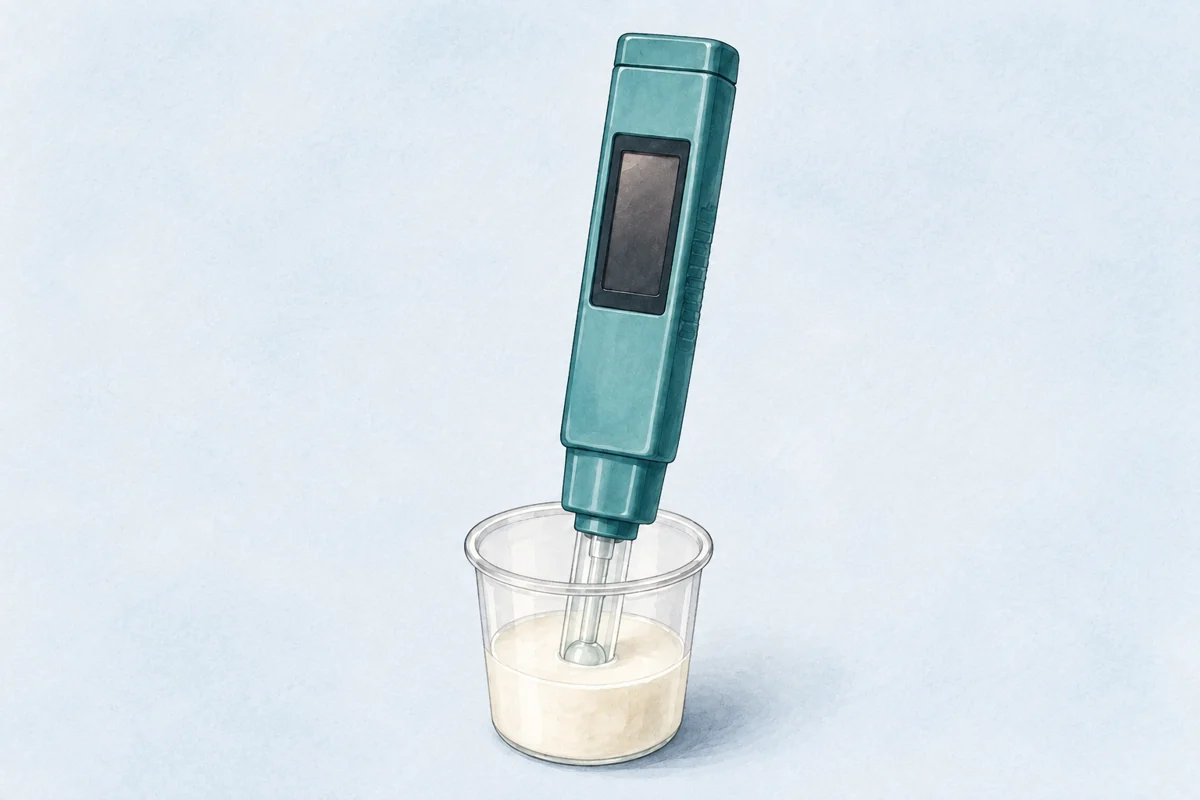
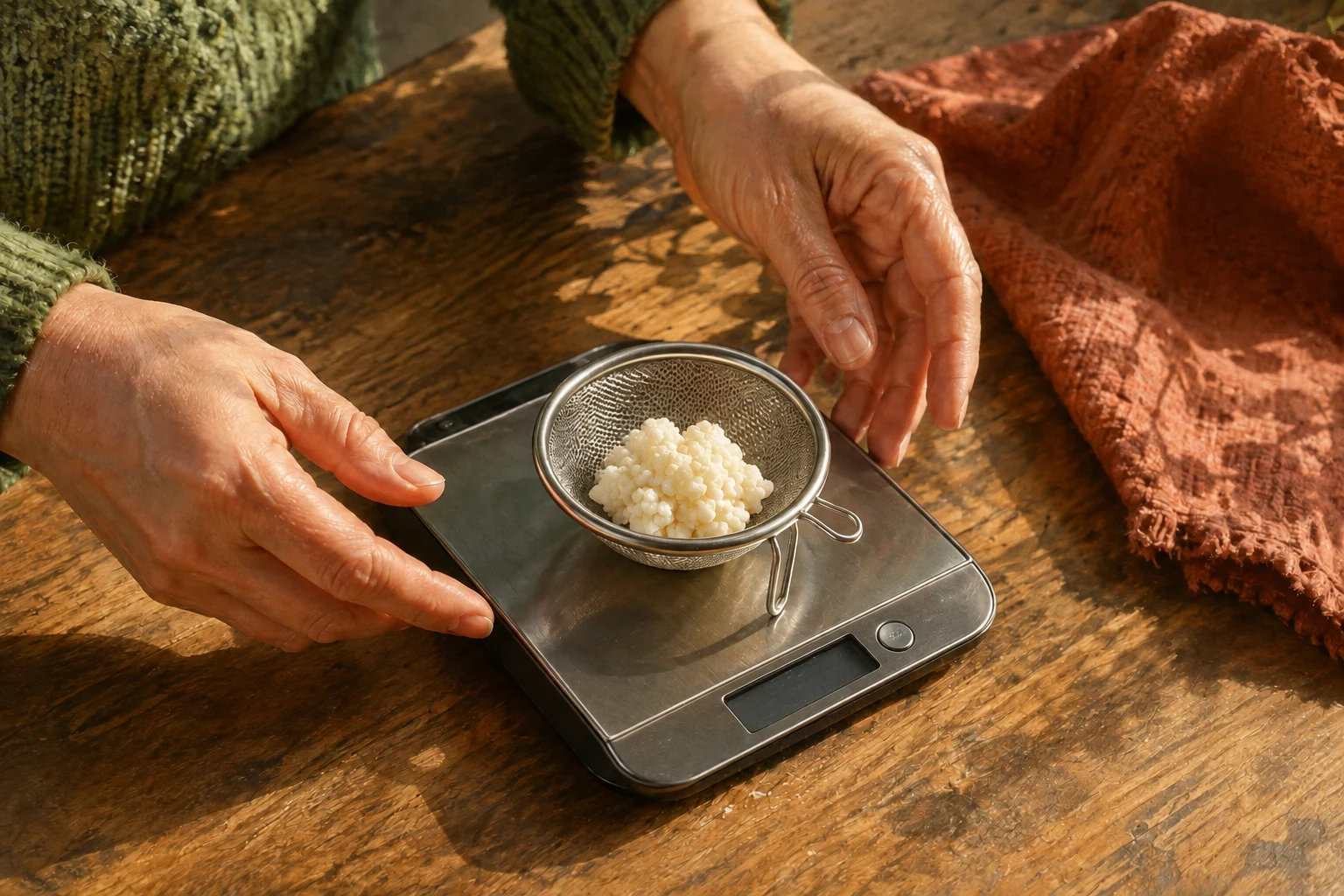
Keep the ingredients, grain weight, liquid volume, container and location the same. Note the actual temperature beside the jar, start and check times, pH readings and visible changes. A photograph from the same angle can make small whey pockets easier to compare.
Copy this blank record into a notebook or phone note. The empty cells are for your observations; they are not example results.
Four batches, one question
These fields stay on this page only. Copy your record before leaving. Blank cells are yours to fill—not example results.
Use the pH measurement guide when readings are inconsistent.
Change one condition, then repeat it
For batch three, choose an adjustment you can describe exactly: a different measured grain amount, one named milk, or a different stable location. Remain within the method’s safe temperature and time limits. Batch four repeats that adjustment.
If the preferred result appears twice, keep the new setup as a working choice and continue observing. Four batches cannot rule out weather, culture recovery or normal variation. If the result does not repeat, write that down rather than adding several more changes.
I changed the milk and the grain amount together. Can I still use the result?
You can record whether you liked the finished batch, provided its process checks passed. You cannot tell which change caused the difference. For the next comparison, hold one of those conditions steady. The temperature and ratio guide helps choose which to adjust.
Keep the result useful
Save the measured recipe, ordinary temperature range, expected finish window and preferred texture. Resume detailed notes after a move, ingredient change or storage break. You do not need to log every normal jar indefinitely.
For milk kefir, failure to reach pH 4.6 or less within 36 hours means discarding the batch, not extending the experiment. For water kefir, use the verified recipe’s complete process limits. Record contamination or a failed process as “discarded”; never taste a suspect jar to fill in a flavour field.
Four batches to compare
- 1Batches 1 and 2
Repeat the ordinary setup to learn its normal variation.
- 2Batch 3
Change one named, measurable condition.
- 3Batch 4
Repeat the change and write the resulting action.
How much record-keeping is enough?
Do I need a spreadsheet?
No. One notebook page, note on your phone, or printed four-row table is enough if the fields stay comparable.
What should I test first?
Test the condition that changed near the time the jar changed: temperature, ratio, ingredient source, storage, or finish time.
When can I stop?
Stop when you can predict the finish and know the one adjustment your routine needs. Start again when ingredients, season, home, or culture history changes.
Research behind this answer
Where to go next


Comments
No comments yet.
Comments could not be loaded.
Join the discussion