
Kefir in soap and skincare: what changes?
The word “kefir” on a soap label tells you about an ingredient. It does not mean you are washing with the living culture in your breakfast glass. Making soap changes the chemistry; making a cream raises a different question about preservation. Here is what the research can tell you before a fermented ingredient becomes a skin-care promise.
Before choosing a product
- 1
A fermented ingredient does not establish a skin benefit.
- 2
Soap making uses a caustic alkali; food-fermentation instructions are not a soap recipe.
- 3
Water-containing creams and lotions need appropriate preservation.
- 4
Trying a little on your skin cannot prove that a mixture is free of harmful microbes.
Why the finished soap is different from the drink
Follow the ingredient through the four stages, from fermented food to a bar that is used and rinsed away.
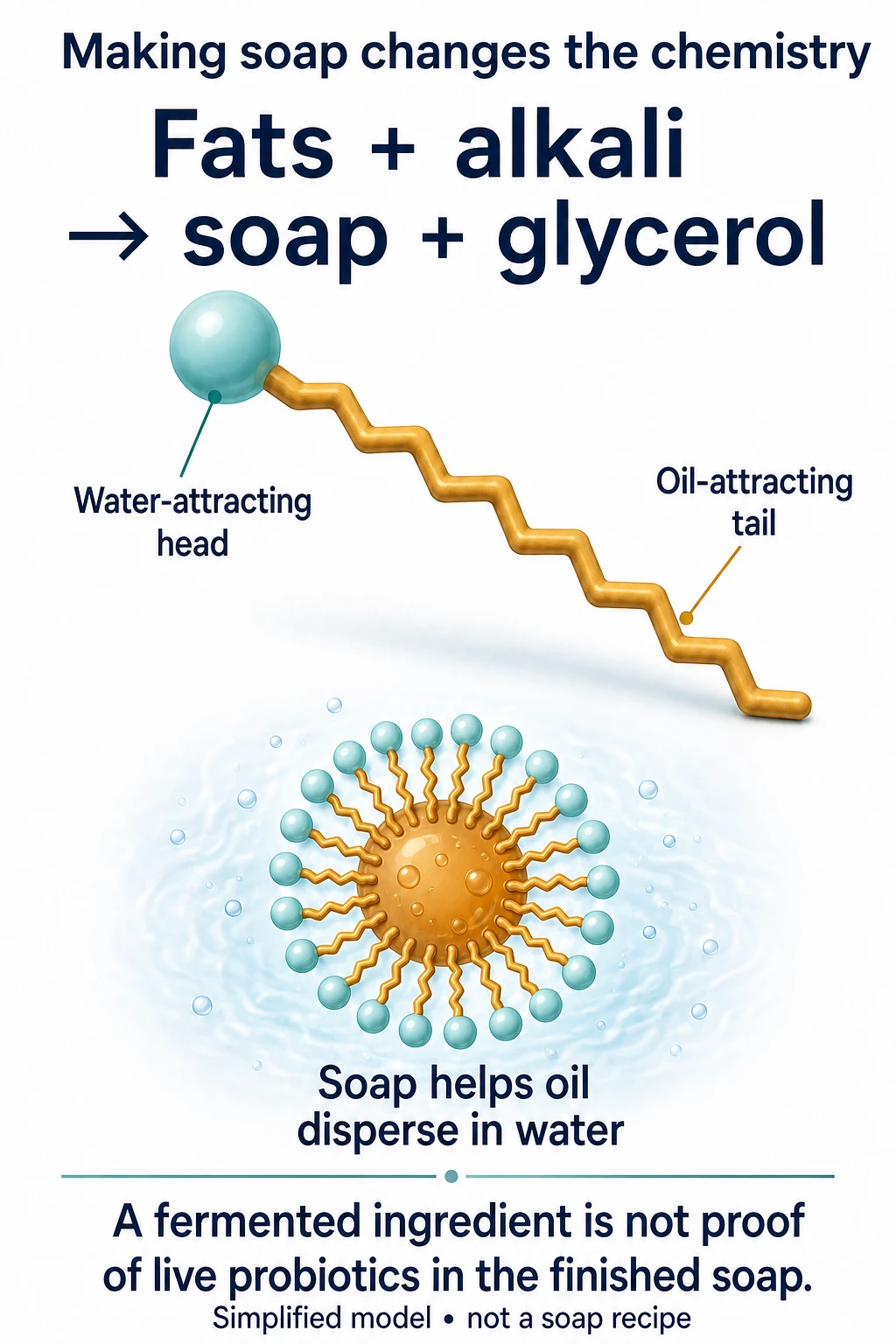
Soap molecules have a water-attracting head and an oil-attracting tail. Around oily dirt, their tails face inward and their heads face the water, helping disperse the oil.
Kefir or separated whey
The ingredient arrives with water, sugars, proteins, and acids. Its exact composition depends on the source kefir and how it was separated or handled.
The oils and alkali must match
Soap forms when fats react with an alkali such as sodium hydroxide. A reliable formula calculates the alkali for its particular ingredients. Adding kefir or whey changes the mixture; it is not a simple substitution for any liquid in any recipe.
High-pH saponification
Oils react with sodium hydroxide to form soap. This is a caustic chemical process, not a continuation of food fermentation.
What remains is a soap product
The fermented ingredient has gone through a different chemical process. Its presence does not demonstrate living probiotic organisms in the bar, or a benefit to the skin microbiome. Those would need evidence from the finished product.
A bar and a cream ask different questions
How long a product stays on your skin, what it contains and how it is stored matter more than the word kefir.
Does the complete soap formula work?
- The oils, alkali and liquid must be specified together.
- Kefir or whey should be assessed within that exact recipe by an experienced formulator.
- The finished bar needs appropriate quality and stability checks; looking firm is not enough.
Will the mixture remain suitable during use?
- Food kefir is not a ready-made cream or preservative.
- The preservation system must suit the whole formula, container and intended life.
- Keeping a mixture cold or trying a patch cannot replace microbial and stability testing.
What would these words on a label actually mean?
An ingredient name tells you what went into a formula. Claims about living microbes, comfort or treatment need evidence about the finished product.
| Label wording | What it establishes |
|---|---|
| Kefir or whey in the formula | Whole kefir, whey and purified extracts are different ingredients. None by itself establishes living microbes or skin benefits. |
| Cleansing or skin comfort | Cleansing is the ordinary purpose of a rinse-off bar. Gentleness, moisturization and freedom from irritation need their own evidence; check ingredients and directions, particularly if fragrance bothers you. |
| Live probiotics or treatment | A fermented ingredient does not show that viable probiotics remain after soap making. The cited research does not establish treatment of acne, eczema, wounds or infection, or antimicrobial protection on human skin. |
Can you put food kefir straight on your skin?
The cited studies do not provide a tested home face-mask or wound-care recipe. A food that is suitable to eat is not automatically suitable to leave on irritated or broken skin.
Do not improvise a lye recipe
Do not estimate sodium hydroxide or copy its amount from another formula. If you want to make soap, use a complete reviewed method and appropriate training in caustic handling; this article does not supply that method.
Acidic food is not a formulated exfoliant
Kefir’s acidity varies and its composition is not the same as a cosmetic with a specified acid concentration and pH. Do not use sourness as a guide to a stronger face treatment. Keep food mixtures off broken skin and away from eyes.
A normal smell cannot prove preservation
A mixture can look and smell unchanged without having demonstrated microbial safety. Do not invent a shelf life for a jar of homemade water-containing skincare.
A patch test answers a narrower question
Trying a small area may reveal a reaction to that product, but it cannot test preservation, contamination or shelf life. Stop using a product that causes irritation; seek medical advice for a persistent or severe reaction.
Keep treatment and food uses separate
For eczema, acne, a wound or suspected infection, seek suitable treatment advice rather than replacing care with kefir. If you have fresh edible kefir or whey to use, the kitchen finder offers food uses instead.
No home skincare formula is provided
What did the soap researchers actually test?
A study can tell us about a bar’s properties without establishing a skin treatment. The methods make that distinction visible.
The 2023 study compared soaps made with goat milk, yogurt or kefir under several storage conditions. It examined pH, physical characteristics, heavy metals, microbial counts and laboratory inhibition. Twenty panelists rated colour, aroma and hardness; this was not a clinical trial of moisturization, eczema or acne.
Read the test before the claim
| Test | What was measured | What it can tell you |
|---|---|---|
| Agar diffusion | Soap solution in a well; measure the inhibition zone. | Growth inhibition under laboratory conditions, not treatment of skin infection. |
| 20 panelists | Colour, aroma and hardness, followed over 12 months. | Product characteristics, not a measured improvement in eczema, acne or moisturization. |
| Product checks | pH, heavy metals and colony counts during storage. | Properties of these tested formulas; not a safety test for a homemade substitute. |
The linked wound studies investigated experimental kefir-derived preparations, including animal work. These were not tests of an ordinary home face mask or proof that kefir soap heals wounds. The preparation and the measured outcome matter.
Open the sourcesSoap and experimental research
- Antimicrobial activity and stability evaluation of soap from caprine milk, yogurt, and kefirJournal of King Saud University - Science, 2023
- Evaluation of wound healing activities of kefir productsBurns, 2012
- Antimicrobial and healing activity of kefir and kefiran extractInternational Journal of Antimicrobial Agents, 2005
- Frequently Asked Questions on SoapU.S. Food and Drug Administration