
Read the bottle
How to read a kefir label
A drink can be fermented without still containing live cultures. A plain dairy product can contain sugar without having sugar added. Tap through the example below to see which part of a label answers each question.
Explore the label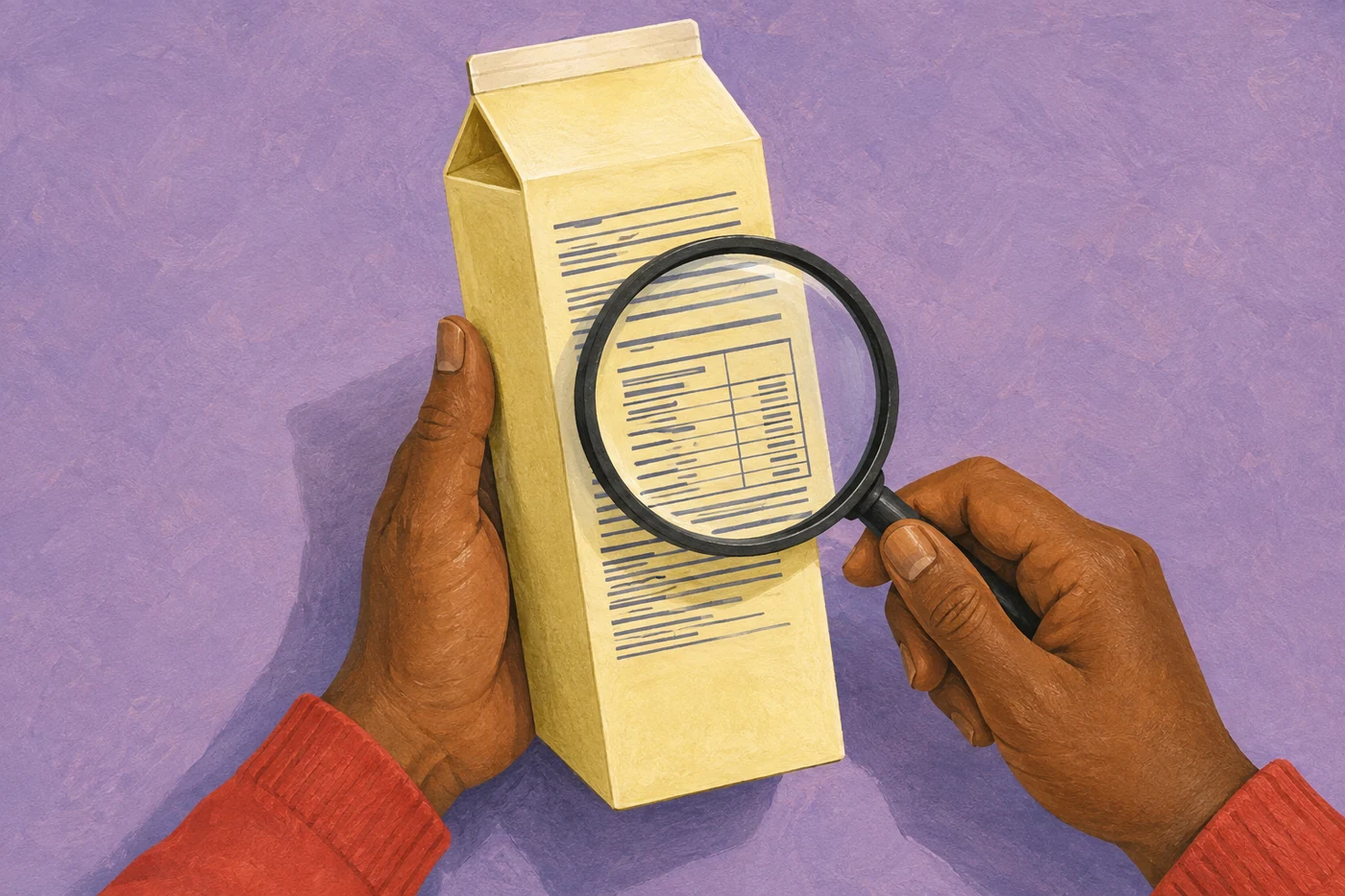
Try an example
What can this label tell you?
This is a fictional teaching label, not a real product. Select a numbered point to explore the information—and the gaps. Real packages use different layouts and wording.
Plain cultured milk
Example kefir
- Base: pasteurized milk
- Ingredients: pasteurized milk, kefir cultures
- Contains live cultures through the printed date
- Contains milk
- Keep refrigerated; follow the printed date
What food is inside?
This example starts with pasteurized milk. On another bottle, it might be sugar water, soy, oats or coconut. Those bases have different flavours and nutrition; “kefir” does not make them interchangeable.
What started the fermentation?
“Kefir cultures” does not tell us whether the producer used grains, a grain-derived culture or a selected starter. This example leaves that question unanswered. If the method matters to you, ask the maker.
Buying a starter yourself? Grains, dried grains and powder need different care.
Are the cultures still alive?
Here, the maker says live cultures remain through the printed date when stored as directed. “Fermented” alone would not answer that question. Heating after fermentation can reduce or eliminate viable cultures.
A live-culture statement also does not prove a particular health benefit. See how food cultures differ from a studied probiotic use.
Is the sugar natural, added, or both?
This example lists milk and cultures, with no added sweetener. Milk naturally contains lactose, so the nutrition panel could still show sugar. On a real bottle, read the ingredient list and nutrition panel together, and compare the same serving size.
Our example does not include a nutrition panel, so it cannot tell you how many grams of sugar are in a glass. The separate practice calculation below shows how a per-100-ml figure changes with the amount you pour.
Put the serving on the same basis
Start with this practice example, or enter the values from your own label. Sugar and total carbohydrate are different figures.
4 g / 100 ml × 250 ml = 10 g
Changing between sugar and total carbohydrate clears the value. Read the correct line on your package before entering it.
Practice example: 4 g sugar per 100 ml. This is not a real product or a recommended serving.Is this suitable for your allergy?
This label says “contains milk”. A lactose-free claim would not remove that milk-protein warning. For milk allergy, choose a verified dairy-free product and check its allergen information. For lactose intolerance, the choices are different.
How should you keep it?
This is a refrigerated example. On your actual product, follow the stated temperature, printed date and instructions after opening; they may give a shorter time once the seal is broken. “Shelf-stable” describes storage before opening, and does not by itself establish whether cultures are alive.
Refrigeration helps preserve a product; it does not undo unsafe handling.
After reading the label
How much will you actually pour?
Source
- Codex Standard for Fermented Milks, CXS 243-2003Codex Alimentarius Commission