
Milk kefir setup
Should you stir milk kefir—and which lid should you use?
You do not have to stir milk kefir. Leave an evenly fermenting jar alone; give it one gentle stir only when the top is thickening much faster than the bottom. Cover the jar to keep out dust and insects, but do not trap pressure in an ordinary primary-fermentation jar.
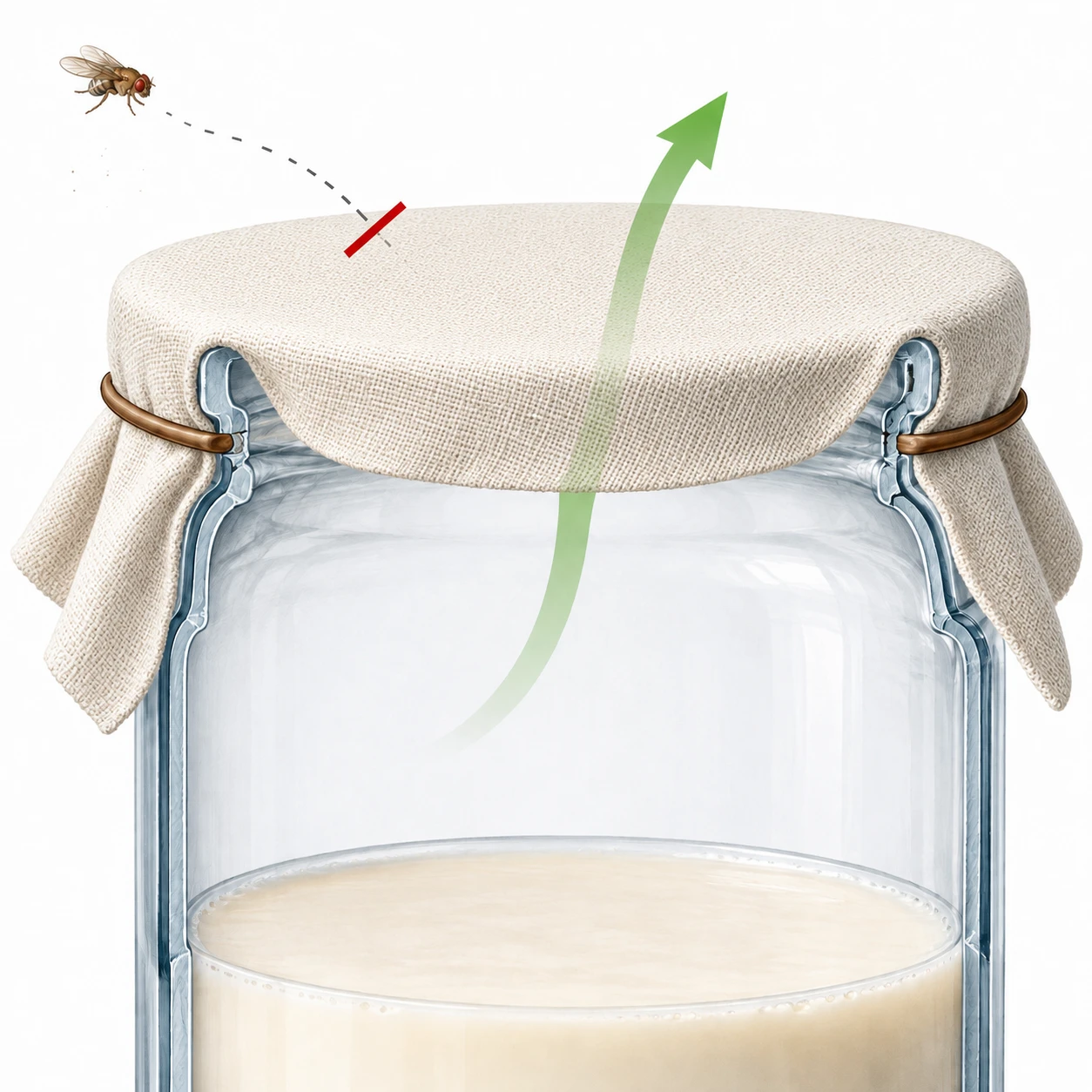
Leave an evenly fermenting jar alone
Grains can ferment while floating or sitting lower in the milk. Gas may lift them; their position alone does not create a need to stir. If the batch acidifies and develops its usual texture evenly, repeated stirring adds handling without a clear benefit.
When a gentle stir may help
If grains collect in a thick upper layer while the milk below remains fluid, one gentle stir with a clean spoon can redistribute contact. Do not vigorously shake a setting gel. Compare with a similar batch before making stirring part of every routine.
The top is thick but the bottom is thin. Does stirring prove it is ready?
No. Stirring redistributes the contents; it does not establish that the whole batch acidified on time. Use the pH measurement method on representative mixed samples and keep the original start time. Milk kefir must reach pH 4.6 or less within no more than 36 hours under the normal process conditions.
Cover against contamination while letting gas escape
Use a clean tightly woven cloth, securely held paper filter, or a suitable loose or vented lid. Keep dust, insects and splashes out. The cover should stay above the liquid and be easy to clean or replace.
Milk kefir does not require an airtight primary jar. Oxygen exposure can affect the microbial activity and aroma, but an ordinary sealed glass jar introduces unnecessary pressure. Use the cover specified by the established method consistently.
A normal jar is not pressure-rated equipment
Fermentation produces gas before glass looks different. Do not seal it into chipped, cracked, decorative or unknown-strength containers. Deliberate carbonation needs a separate verified method matched to suitable equipment after grain removal; cold flavouring is the simpler option.
A distorted lid, leaking seal or suspected extreme pressure needs the container maker’s safe handling advice. Keep people away and do not casually move or open damaged glass. Chilling cannot repair the container.
Make the routine easy to repeat
Use clean equipment, fresh pasteurized milk, a consistent cover and planned checks. Observe the jar before stirring, and strain only after the method’s process checks are met. If texture remains uneven, compare temperature and grain ratio rather than adding more handling steps.
Two common questions
Do kefir grains need oxygen?
The mixed culture can ferment under different oxygen conditions. A breathable cover or loose lid is the easiest pressure-free home setup.
Does stirring make kefir thicker?
Not reliably. It can even out one batch, but milk protein, temperature, grain ratio, and the point at which you strain have a larger effect on texture.
Research behind this answer
Where to go next


Comments
No comments yet.
Comments could not be loaded.
Join the discussion