
Buying kefir
How to choose kefir
Bottles can all say “kefir” and give you very different things: a plain cultured milk, a sweet fruit drink, or a dairy-free ferment with little protein. Before comparing billions of bacteria, check what you will actually be drinking.

What do you want it for?
The useful comparison depends on what the kefir will replace:
- For breakfast or a snack, compare the protein and calcium with the food you usually eat.
- For a cold drink with lunch, think about taste, sugar and the size of the glass.
- For lactose intolerance, distinguish ordinary milk kefir from a clearly labelled lactose-free product.
- For a specific probiotic purpose, look for the organism, preparation and amount supported by relevant studies.
- For avoiding dairy, check the ingredients and allergen information, including any culture grown in milk.
Start with what was fermented
Milk kefir is a cultured dairy food. It can contribute protein and calcium, but the label tells you how much. It still contains milk proteins, and ordinary milk kefir can retain lactose.
Water kefir is a sugar-water ferment. It can make an enjoyable light drink, but it does not replace milk’s protein or calcium. Sugar and alcohol can remain after fermentation, especially in variable homemade batches.
Soy, oat and coconut kefirs reflect their different bases and recipes. Compare protein, carbohydrate, saturated fat and any fortification on the actual pack. FDA explains these differences between plant drinks.
If milk usually gives you gas, kefir may be easier to tolerate: a small controlled study found better lactose digestion with plain kefir than milk. Milk allergy is different. Lactose-free milk kefir still contains milk proteins and is unsuitable for milk allergy.
Live cultures and culture method answer different questions
“Contains live cultures” describes the finished food. Follow its printed storage directions and date. A product heated after fermentation can still be fermented food, but that wording does not establish that its cultures remain alive. The Codex fermented-milk standard distinguishes heat-treated products.
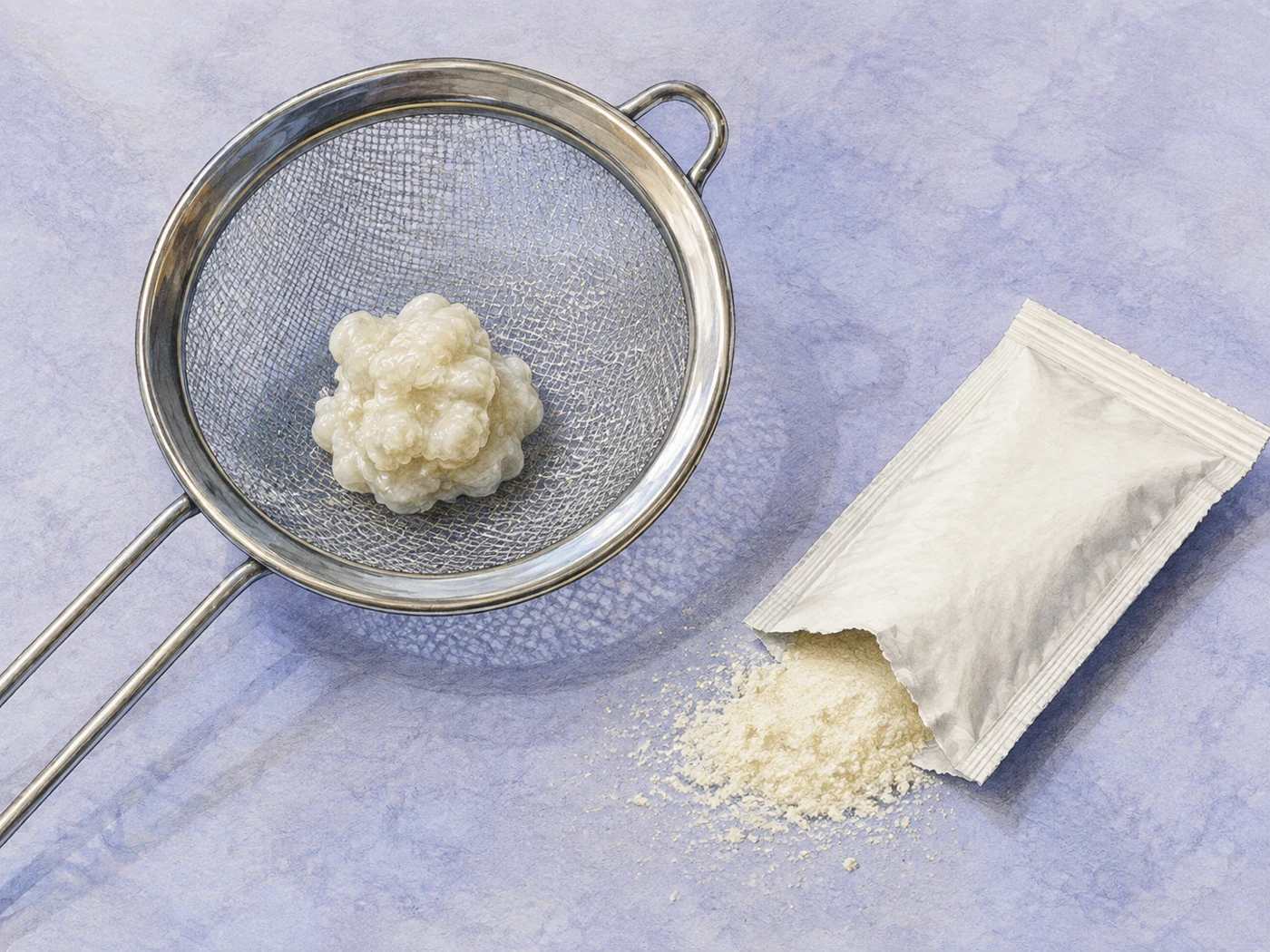
Grains or selected starter cultures describe how fermentation began. Grains are reusable communities of bacteria and yeasts; a starter can supply a chosen combination. Neither automatically produces a better product for every purpose. Some labels do not disclose the method, so ask the maker if it matters to you.
“Homemade” and “shop-bought” do not settle the culture question. Both can use different preparations. If you want to make kefir yourself, grains, dried grains and starter powder need different instructions.
Read the ingredients beside the nutrition panel
A plain milk kefir can show sugar on its nutrition panel because milk contains lactose. That number does not mean the maker added table sugar. Read the ingredients for sugar, syrups or sweetened additions, then use the nutrition panel to compare the finished drinks.
Be careful with serving sizes. If one label gives values per 100 ml and another per bottle, put them on the same basis before choosing.
For example, a teaching label with 4 g sugar per 100 ml gives 4 × 250 ÷ 100 = 10 g sugar in a 250 ml bottle. That does not tell you how much was added; read the ingredient list for that distinction.
Enter your own label and serving in the label guide’s serving calculator to compare the same amount.
Plain kefir lets you adjust the sweetness yourself. Use fruit in a smoothie, or keep it savoury in a dressing. Thickeners are not proof of a bad food; they help explain its texture. Choose ingredients you want and can tolerate.
If blood glucose is your concern, count the carbohydrate in the amount you drink. A fermented label does not cancel the carbohydrate, and clinical results have been mixed.
What about billions of bacteria?
CFU is a laboratory estimate of organisms able to grow under the testing conditions. A bigger number, or a longer list of species, does not by itself prove a greater health effect. For a specific probiotic use, look for evidence tied to the organism or combination, preparation, amount and intended outcome.
A food may suit your meal; a studied probiotic product may suit a specific purpose. Kefir and probiotics are worth comparing on that basis, without assuming either wins automatically.
Before it goes in the basket
- The base fits how you want to use it.
- The ingredient and allergen information fits your needs.
- If you want live cultures, the finished-product statement is clear.
- You have compared nutrition for the amount you will actually drink.
- You can follow the storage instructions and use it within the printed limits.
If an unanswered label question would change your choice, ask the producer before buying. You do not need a strain list to enjoy a food, but you do need a clear answer about something as important as an allergen.







Comments
No comments yet.
Comments could not be loaded.
Join the discussion